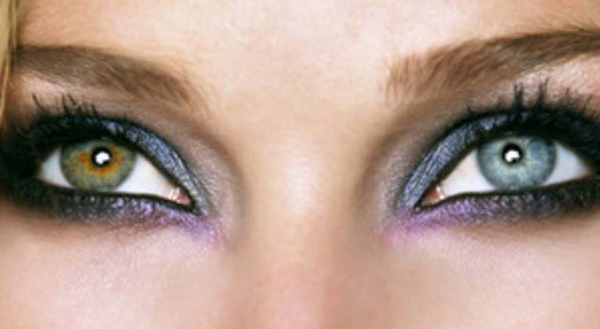
EyeMax – “The Eye, Part 5”

Greetings anatomy students! Whew! Nine weeks have elapsed since our first eye lesson and today marks the final installment about the effective, efficient, elegant eye. So, welcome to today’s Anatomy Lesson #33, EyeMax – The Eye – Part 5.

The lesson contains some fun tests to perform with our eyes. You know the drill: try this – try that. It also includes possible spoiler alerts with excerpts from two of Diana’s later books; as always, no names, no dates, and no places are revealed.

Let’s begin where we left off with The Eye – Part 4. We have already covered most eye structures so today we will finish with two humors of the globe, retina and visual centers of the brain.

You may recall that the eyeball has three important chambers: anterior chamber between iris and cornea (Photo A, red area); posterior chamber between iris, lens and suspensory ligaments  (Photo A, green area); and the large vitreous chamber behind the lens (Photo A, blue area). You may also recall the ciliary body (Photo A, red arrow); it contains the ciliary muscle, attaches to suspensory ligaments/zonular fibers (Anatomy Lesson #32), and produces aqueous humor (humour).
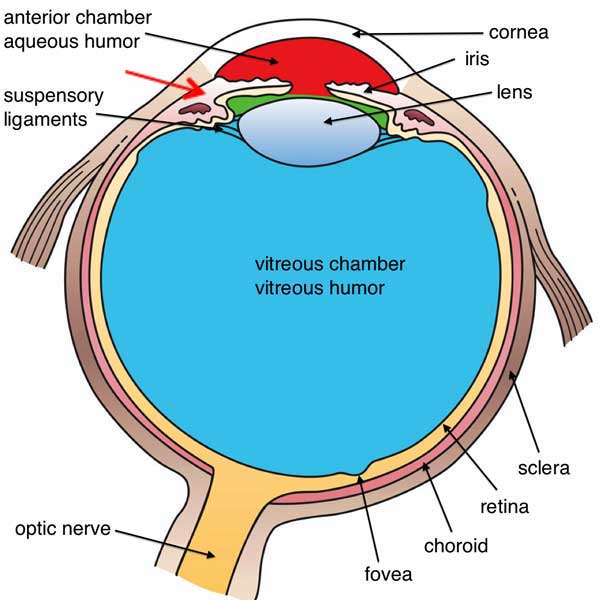
Three_Internal_chambers_of_the_Eye-copy-KLS-edited

Photo A

As watery  aqueous humor is made by the ciliary body, it collects in the posterior chamber and then flows forward through the pupil into the anterior chamber (Photo B). A spongy trabecular meshwork fills the angle between cornea and iris (Photo B) and contains the canal of Schlemm, a circular lymphatic-like vessel. From the anterior chamber, aqueous humor drains into the canal of Schlemm and from there into the venous system. A normal eye produces and absorbs about 3-4 ml (~¾ tsp.) of aqueous humor every 24 hours; a delicate balancing act thus exists between production and absorption of this fluid..

Aqueous humor serves two main purposes; it provides oxygen and nutrients to parts of the avascular lens and cornea and it assists the corneal refraction of light rays.
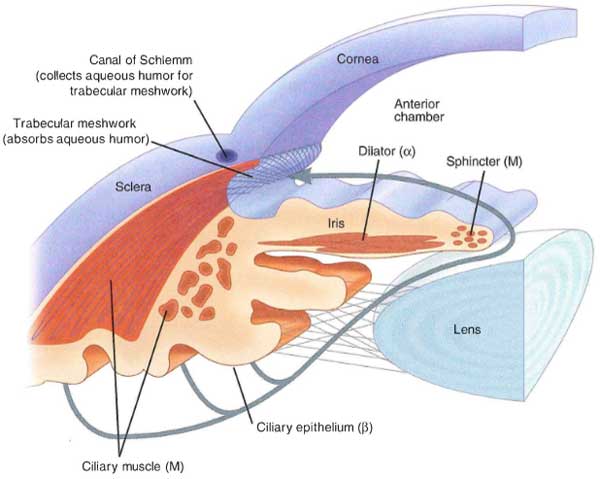
aqueous_humor_pathway1350334932545

Photo B

For those preferring a video, this gif shows production and absorption of aqueous humor:

But, sometimes the unthinkable happens and production of aqueous humor outstrips absorption. The eye is a closed system (no external opening), so if aqueous humor builds up, then intraocular pressure (IOP) rises. Known as glaucoma, this condition must be diagnosed and controlled with medication or surgery (or both) otherwise the optic nerve may be damaged resulting in decreased vision or blindness. Understand that glaucoma is not a single condition, rather, there are several different types of glaucoma.

POSSIBLE SPOILER ALERT and Clinical Correlation #1: In Diana’s 6th book, A Breath of Snow and Ashes, our ever resourceful Claire treats a patient with an acute attack of closed-angle glaucoma (a true medical emergency)!

I had long suspected that the cause of (her) blindness was glaucoma—rising pressure inside the eyeball that if untreated eventually damages the optic nerve. She was plainly having an acute attack… I abstracted the largest needle, a three-inch length of steel… The left eye bulged noticeably beneath its lid, vividly bloodshot… With a quick prayer to Saint Clare—who was, after all, patroness of sore eyes, as well as my own patron saint—I ran the needle through the flame of the lamp, poured pure alcohol onto a rag, and wiped the soot from the needle. I shoved the needle hard into the sclera of the eye, near the edge of the iris.

Closed-angle glaucoma occurs because the Canal of Schlemm is blocked or does not drain properly so aqueous humor accumulates with a sudden and dramatic increase in IOP (Photo C). Although crude, Claire’s 18th century treatment (no access to modern medications and procedures!) released aqueous humor from the anterior chamber relieving IOP. Her treatment could not restore sight, but it could offer the patient temporary relief from horrific pain.
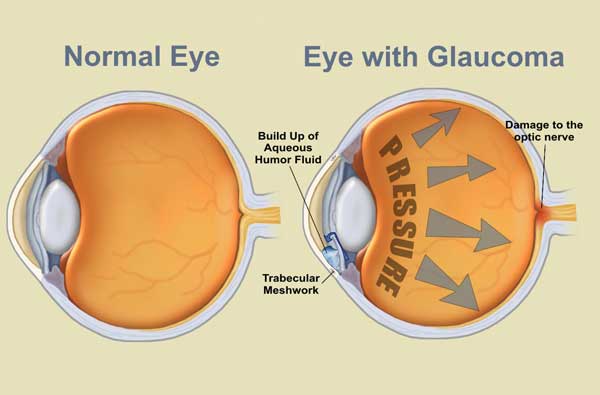
photo-c-glaucoma

Photo C

The vitreous humor (vitreous body) is a transparent, avascular gelatinous mass occupying the vitreous chamber (see Photo A). Photo D is a model illustrating the vitreous as a blue mass marked by the black line. Vitreous humor is mostly water but other molecules lend it a gel-like consistency although it may liquefy with age. Unlike aqueous humor, the vitreous is not continuously renewed. Vitreous humor serves three important functions: it fills the globe augmenting its spherical shape, it secures the retina by pressing it against the choroid coat (see Photo A), and it helps refraction of light rays.
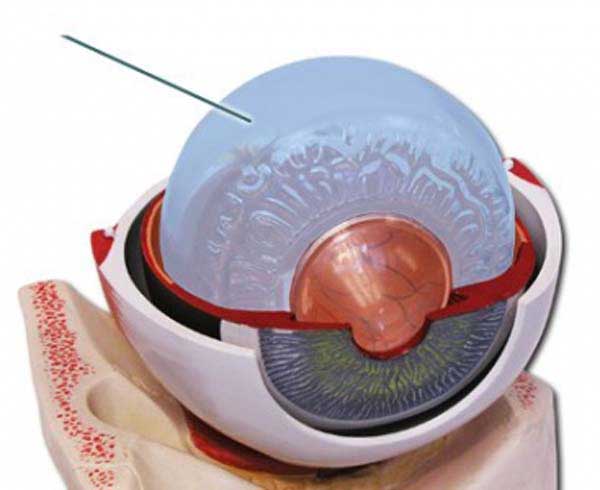
photo-D

Photo D

Now, let’s consider the complex retina and its parts. The extensive retina covers about 65% of the inner surface of the eyeball (Photo E – yellow layer).
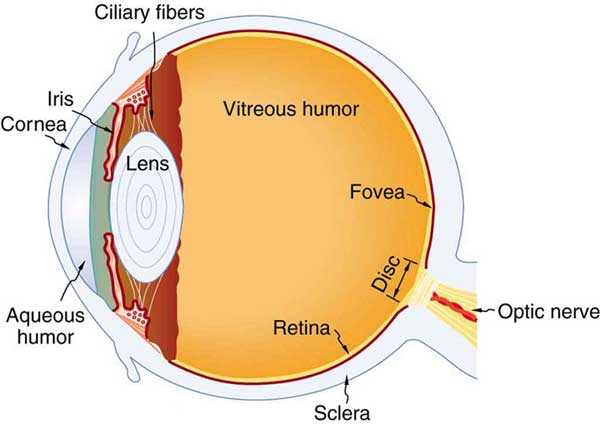
eye-20with-20labels-KLS-edited

Photo E

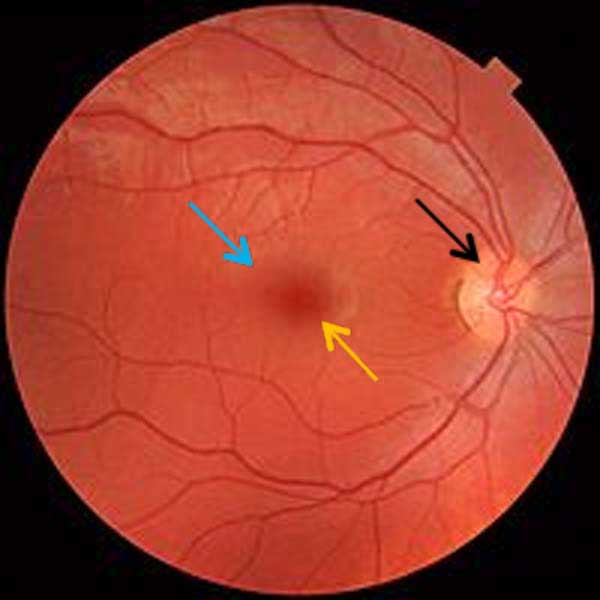
As an eye specialist peers into your eye via ophthalmoscope, the fundus or back of the eyeball is revealed. In everyday terms, the photographic red eye is a reflection of light from the fundus of the eye.

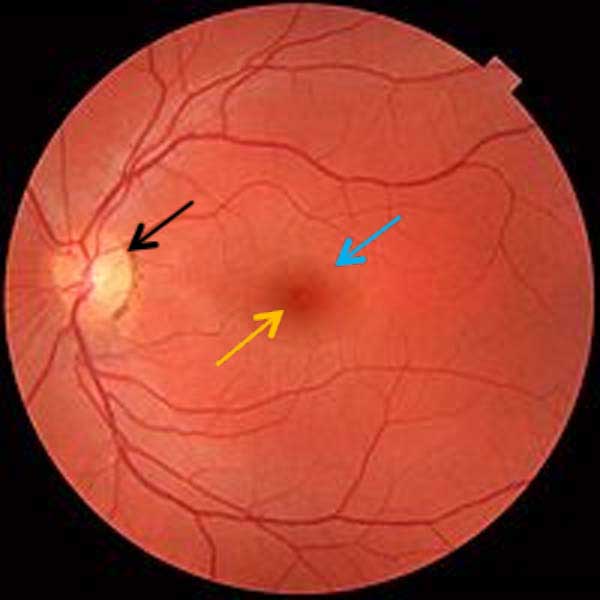
Viewing the fundus reveals the inner surface of the retina, an extension of the brain. Photo F is the fundus of a right eye and Photo G is the fundus of a left eye. Each black arrow points to the bright optic disc or blind spot, where the optic nerve (Cranial Nerve II) forms; sight is absent at the blind spot because it lacks photoreceptors (see below). Red branches emerging/converging at each optic disc are retinal vessels that provide oxygen and nutrients to or remove waste products from the inner retina. Blue arrows point to the maculae (pl.), pale regions each containing a dark central spot, the fovea (orange arrows). Each fovea contains the fovea centralis, a central pit marking the site of greatest visual acuity.

Fundic examination is important because it helps reveal the health of the retina; it is also the only site where the microcirculation (small blood vessels) can be observed and the only region where part of the brain can be seen directly without tissue disruption or intervention.

Clinical Correlation #2: Macular degeneration (MD) is a common disorder causing decreased visual acuity and even blindness. This condition is aptly named because retinal cells of the maculae are damaged along with other associated changes. There are several types of MD with various risk factors but the most common is age-related MD and it is considered incurable. As always, science presses onward and (mostly) upward! Last month London eye surgeons treated a British patient using a tiny patch of stem cell-derived tissue to successfully restore eyesight lost through macular degeneration!
untitled-1-copy-KLS-edited

Photo F

untitled-(2)-copy-KLS-edited

Photo G

Hey, hey, students!  Are ye awake and paying attention?  JAMMF is checkin’ ye out just to be sure!

gif.tumblr_inline_nbihqi9Pl41sz37xy

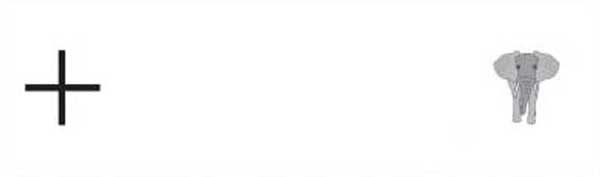
Try this: Let’s test our blind spots the sites where optic nerves form. Close your left eye and stare with your right eye at the cross in Photo H. You should see the elephant in your peripheral vision but keep focused on the cross. If you can’t see the elephant, then move away from the screen until you can. While looking at the cross, slowly move closer to the screen. At about one foot (~ 31 cm) away from the cross, the elephant will disappear from view because its image is falling on your right blind spot! Now, for fun, close the right eye and stare at the elephant. Move in and out until the cross disappears; again, this happens because its image is falling on your left blind spot. Excellent job, students!
blind-spot-copy-KLS-edited

Photo H

Try this: Let’s test our fovea centrales (pl.) by staring at the words “Jamie and Claire” in the sentence below; these words should be crisp and clear because their images fall directly on the fovea centrales of our retinae (pl.), sites of greatest visual acuity. Notice that the remaining words of the sentence are unclear because their images fall elsewhere on the retinae where vision is less acute.

FANS ARE HEAD OVER HEELS FOR JAMIE & CLAIRE, OUR FAVORITE SI-FI CHARACTERS.

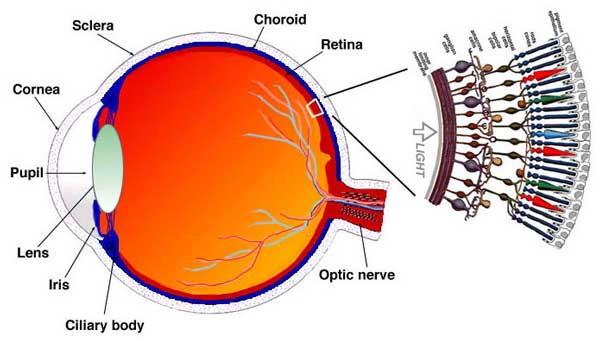
Returning to retinal anatomy Photo I (right side) shows an enlarged graphic representation of the retina. The retina has about 10 named layers, but for this lesson we will cover only three.
Sagschem-KLS-edited

Photo I

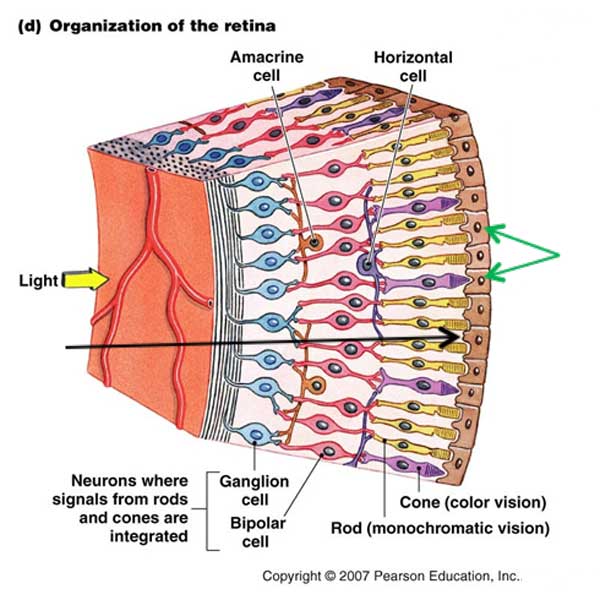
Photo J is a schematic of a wee bit of retina (cornea lies to the left). The yellow arrow shows light rays approaching the retina. The black arrow shows that light rays pass through the retina until they reach a layer of  rods and cones, two types of photoreceptor cells. Some light rays bypass the rods and cones to reach the deeper retinal pigment epithelium or RPE (Photo J – green arrows). RPE contains brown melanin that absorbs extraneous light rays bypassing rods and cones and thus improving our quality of vision.

To the left of the RPE are the photoreceptive rods and cones. Cones (Photo J – lavender cells) are responsible for chromatic (color) vision. Rods (Photo J – yellow cells) are responsible for achromatic (non-color) vision. To the left of rods and cones are several other retinal cell types which we will not cover. However, the innermost layer are ganglion cells; their processes (axons) form the optic nerve (Photo J – blue cells).
retina-layout-KLS-edited

Photo J

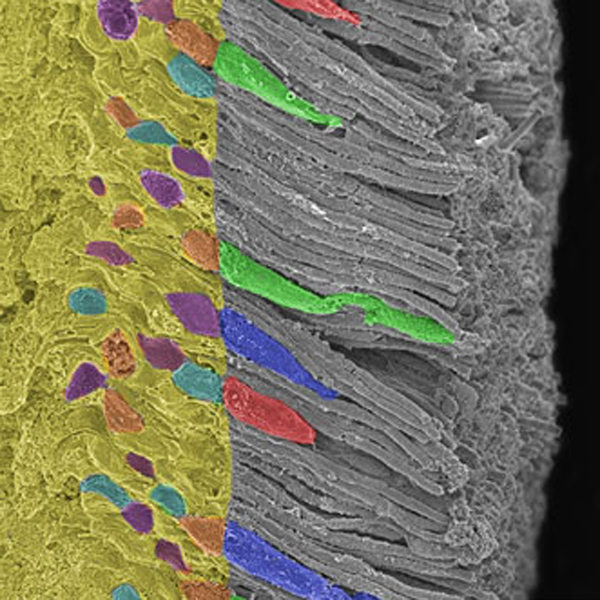
Photo K shows rod and cone cells by scanning electron microscopy (RPE is absent); the names derive from the shape of their outer segments. Rods cells have long, thin outer segments (Photo K – grey columns). Cone cells have cone-shaped outer segments (Photo K – artificially colored blue, green or red). Rod and cone outer segments contain photosensitive molecules that respond to light.

Each human retina contains about 120 million rod cells that are absent from the fovea but increase in numbers away from the fovea. Rods contain one type of photosensitive molecule, respond to dim light and are used for night vision; they play little or no role in color vision. Amazingly, experiments have shown that a single photon (elementary particle) of light can activate one rod cell.
cone-cells KLS edited

Photo K

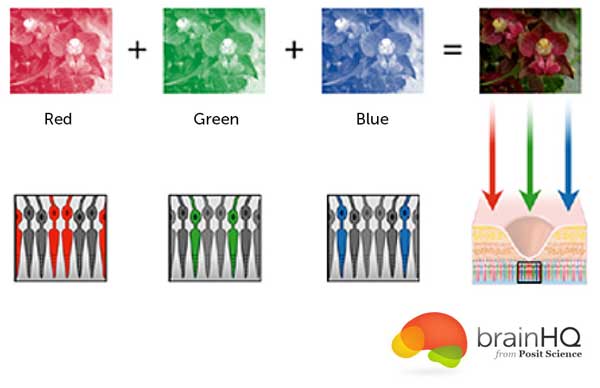
The retina contains about 6 million cone cells that are concentrated in the fovea but decrease in numbers away from the fovea. Cones contain one of three types of photosensitive molecules that vary slightly in configuration: L cones respond to red (long-wave length) light, M cones respond to green (medium-wave length) light and S Cones respond to blue (short-wave length) light. Working together, the three types of cones give us color vision (Photo L). Cones function best in bright light, perceive finer visual details and respond faster to stimuli than rods. The cone-rich fovea is the only area of the retina where 20/20 vision is achievable and is critical for seeing fine detail and color. Truly fascinating fact: recent studies suggest that some women may have a fourth type of cone and perhaps a broader perception of color although future studies are needed to define this phenomenon.
vision-works-02

Photo L

Hey now! Don’t get all bleary-eyed on me. Take after Himself here and open up them peepers! There’s more to come!

gif.tumblr_nkhqcbg0ZG1u2pyxyo2_250

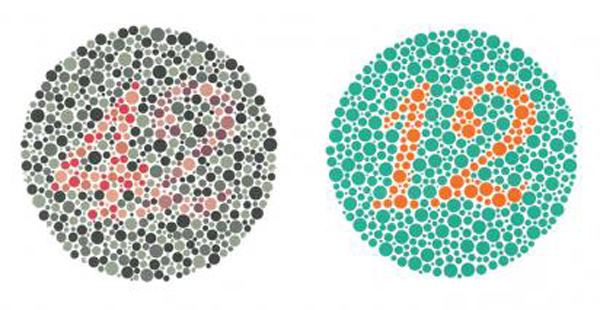
Clinical Correlation #3: As you are aware, some folks are red-green color blind lacking the inability to detect green and/or red colors. About 1 in 50 people, mostly men, lack functioning red- and/or green-sensitive cones, leaving them able to experience only one or two main colors.

Try this: Gaze at Photo M – left image; what do you see? Gaze at Photo M – right image; what do you see? People with normal color vision see a faint number 42 in the left image and the number 12 in the right. People who are red-green color blind cannot see either number.
color blindness KLS edited

Photo M

Clinical Correlation #4: Most humans see a wondrous array of colors such as the dishes of powered pigments shown in Photo N. But, some people have achromatopsia meaning they see no color at all and their visual experience consists of different shades of grey ranging from black to white, a bit like images from a black and white TV set (Photo O). Achromatopsia is extremely rare, effecting about one in 33,000 persons.

pigment KLS edited

Photo N

pigment_g KLS edited

Photo O

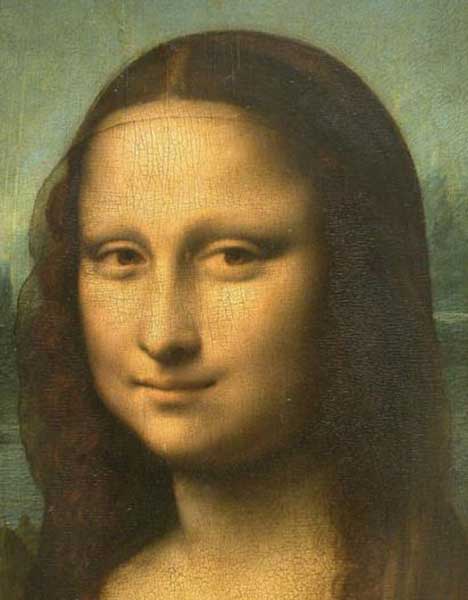
Try this: Here’s one last demonstration to compare differences between rods and cones. In 2002, neurobiologist Margaret Livingstone found that the Mona Lisa (Photo P) demonstrates the different processing capabilities of rods and cones. Because da Vinci painted the lips with low-detailed brush strokes, rods perceive this feature better than cones. The eyes were painted with high-detailed brush strokes best perceived by cones. Thus, her test subjects who stared at the mouth, saw the lass as less cheerful than if they focused on her eyes. As Livingstone put it, “She smiles until you look at her mouth, and then it fades, like a dim star that disappears when you look directly at it.” Try it and see if it works for you.
fwk-stangor-fig04_028-KLS-edited

Photo P

Now, time has come to put everything together. Take a deep breath and let’s “see” how normal vision works in three easy steps! Ha, ha.

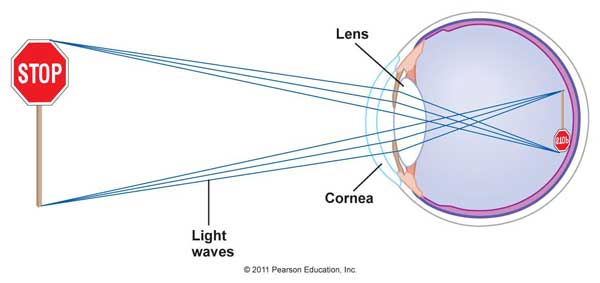
Step #1 – Light from object to retina: think of each eye as a separate camera and imagine looking at a stop sign (Photo Q). Because each eye faces forward and is housed in a different bony orbit, each eye detects a slightly different image of the stop sign. As light rays travel from the stop sign, they strike the corneas and are refracted; then, lenses and humors add further refraction such that the image arrives at the retina upside down and backward (Photo Q). I didn’t mentioned this wee fact before but ‘tis true!
eye-focusing-rays-of-light-figure_10_24_labeled-KLSedited

Photo Q

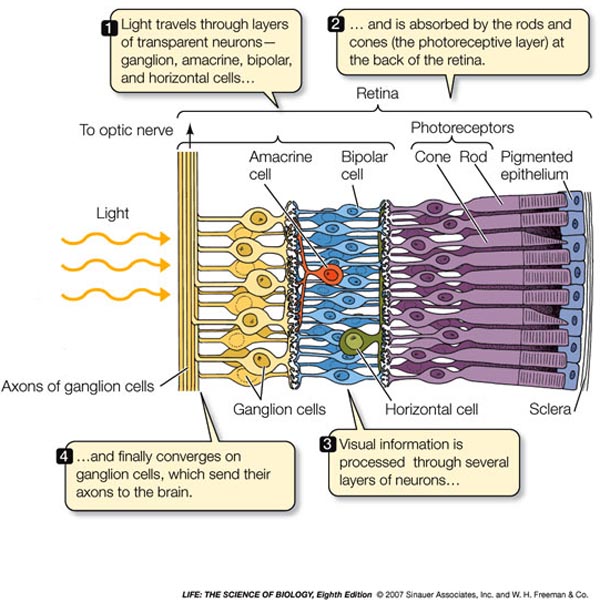
Step #2 – Light activation of rod and cone cells: Light rays from the stop sign pass through the retinal layers (Photo R – box 1) to reach rods and cone cells. Photons strike photosensitive molecules of rod and cone cells (Photo R – box 2) and presto, MAGIC! Just joshing you…. Light rays striking the photosensitive molecules causes them to undergo phototransduction, a complex process wherein light photons are converted into electrical signals that propagate back through the retinal cells to the ganglion cells (Photo R – box 3). Signals reach the ganglion cells and follow their axons to the optic nerve (Photo R – box 4).
f45021 KLS edited

Photo R

Step #3 – Projection of visual electrical signals to the brain: This step is challenging but stay with me, students! Step three is where everything comes together!

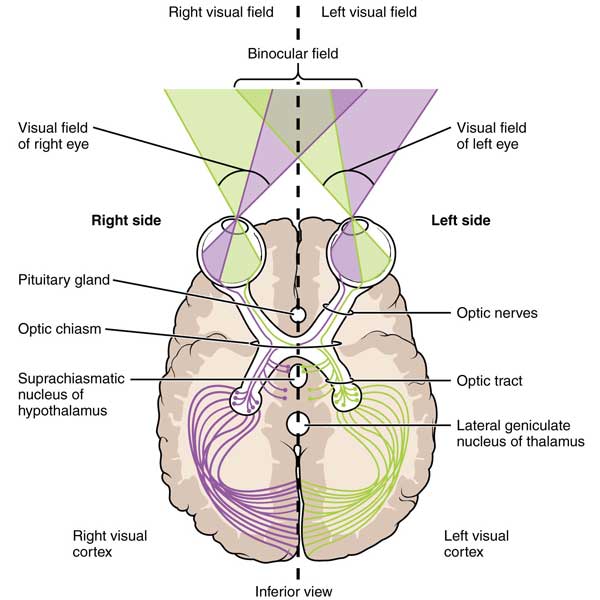
NOTE: Photo S is a schematic of eyes, optic nerves and brain as if seen from a patient’s feet; thus, the subject’s right is on your left! OK, hold on and let’s go!

Retinal signals from the stop sign image follow the optic nerves, each a bundle of about one million axons. Optic nerves form at the back of each eyeball and meet just behind the pituitary gland at the optic chiasm (Photo S). Here nasal retinal nerve fibers cross over such that fibers carrying signals from the right temporal retina (lavender) and the left nasal retina (lavender) project to the right visual cortex (lavender) of the brain; fibers carrying signals from the left temporal retina (green) and the right nasal retina (green) project to the left visual cortex (green). The visual cortices (pl.) are located in right and left occipital lobes of the brain. Crossing over (decussation) of the nasal fibers aids in the integration of visual information. After the chiasm, the optic nerves are renamed optic tracts. Optic tracts have other connections along the way to the visual cortices but these are beyond the scope of this lesson.

Try this: Open fingers of one hand and grip the most projecting part of the back of your skull; this is your occipital bone (from Latin ob, behind, and caput, head). Both occipital lobes lie deep to the occipital bone.

Visual cortices are essential for vision because, here, the stop sign image from each retina is received as electrical signals. Occipital cortices integrate info, recognize form, identify objects, determine location, evaluate spatial cues, detect motion and provide memory. They also augment depth perception where visual fields from both eyes overlap (Photo S – binocular field). The cortices also relay info to other brain sites involved with balance, meaning, etc.

Understand that if vision is normal, all three steps occur in fractions of seconds. Neuroscientists perform numerous studies to discern how the visual cortices work. Simply put, eyeballs collect visual information but we “see” with our brains!
1420_Optical_Fields-KLS-edited

Photo S

Peek to the right…peek to the left…do you see what I seeee?

gif.tumblr_ncg1az9rOc1qa56ewo1_250

Possible Spoiler Alert: Speaking of depth perception, our genius author, Diana, writes about binocular vision in her 5th  book, The Fiery Cross: here our beloved Claire treats another patient:

“You don’t have any binocular vision,” I said… He looked down into the palm of his hand, closing one eye, then the other, as though some answer might be found among the lines there. “Your eyes are fine,” I assured him. “It’s just that they don’t work together… for one reason or another, the brain never learns to merge the images coming in from both eyes in order to make a three-dimensional image.”

The ability to see in three dimensions is called depth perception, binocular vision or stereoscopic vision. Claire (Diana, snort!) is absolutely correct; if the eyes (and extraocular muscles) are otherwise normal, the ability to see in 3-D occurs in the brain. Recall that each eye collects a slightly different version of an object because our eyes face forward and each lies in a different bony orbit (if our eyes were on the sides of our heads we would not enjoy depth perception). The visual data from the two slightly different images are sent to visual centers of the occipital lobes and there is integrated into a single 3-D image. Our amazing brain does this instantaneously without conscious direction!

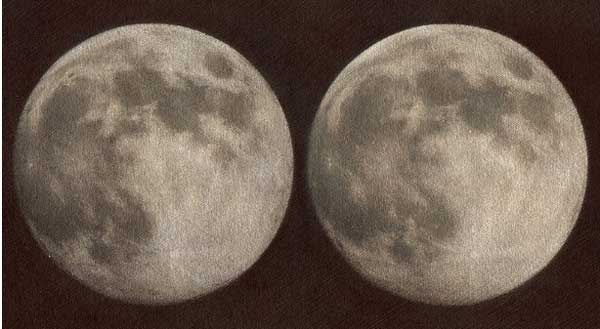
Try this: Photo T is a pair of stereoscopic photos of the moon. With your face about 10 cm / 16 inches from the screen, widen your eyes slightly. Now, gently start to cross your eyes until the moons fuse into a 3-D moon in the center. If you can perceive the depths of the moon’s cratered surface, this is was done by your remarkable brain! Did it work? If not, try the next image.
Detached%20Observers%20Stereoscopic%20Drawing_Cargo_905px-KLS-edited

Photo T

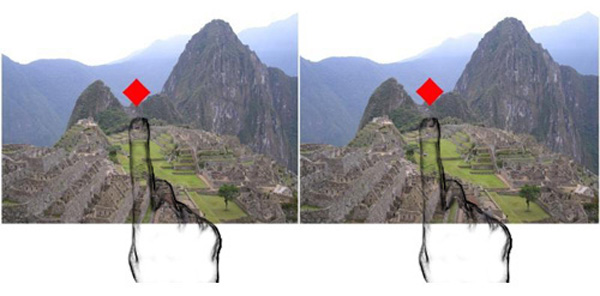
This is a pair of stereoscopic images of Machu Picchu each overlain with a red diamond and an outline of the hand (Photo U). Gaze at the two images using the screen distance mentioned above. Gently cross eyes until the two diamonds fuse into one central 3-D diamond. See the city with mountains behind it? Grand!
trainer-image1 KLS edited

Photo U

Some students have asked for explanations of nearsightedness and farsightedness so let’s finish the lesson with these topics. The following are simplistic explanations because optical science is detailed.

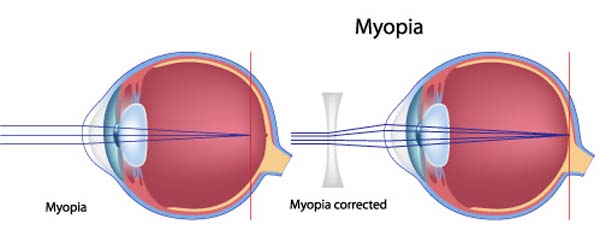
Myopia, also known as being nearsighted (US) or short-sighted (Britain), is a condition wherein light entering the eyeball focuses in front of the retina rather than directly on it (Photo V – left image). Close objects appear in focus but distant objects are blurry. In most instances, myopia is caused by an elongated eyeball or a steep corneal curvature and the eye’s lens cannot correct the problem. Nearsightedness can be treated with eyeglasses, contact lenses or refractive surgery.

Myopia can be corrected using a diverging lens that spreads light rays from distant objects bringing them to focus on the retina (Photo V – right image). An eye specialist determines the correct lens for myopia using optical measurements of the eye.
illustration_myopia KLS edited

Photo V

This is a startling statistic: twenty-five percent of the world’s population is nearsighted and the rate is increasing (Photo W)! Evidence suggests that indoor living, close work (e.g. computers), and inside play are contributing factors. A recent Chinese study showed that children who played outdoors 40 minutes longer per day than a control group had a 23% reduced likelihood of developing myopia (JAMA, Sept. 15, 2015). Reminder of the adage, “use it or lose it!”

6618191-14343503424769633-Richard-Berger-KLS-edited

Photo W

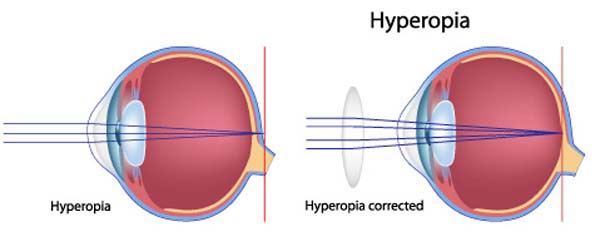
Hyperopia, also known as farsightedness (US) or long-sightedness (Britain) is a condition wherein light entering the eyeball focuses behind the retina rather than directly on it (Photo X – left image): close objects appear blurry but distant objects are in focus. In most instances, the eyeball is too short or the cornea is too flat and the eye’s lens cannot correct the problem. Farsightedness can be treated with eyeglasses, contact lenses or a lens implant.

Hyperopia can be corrected using a converging lens that bends light rays from near objects to focus on the retina (Photo X – right image). Again, an eye specialist determines the correct lens for hyperopia using optical measurements of the eye.
illustration_hyperopia KLS edited

Photo X

Okay, students, the bell just rang and this lesson is over. But, let’s not leave without at least one more glimpse of Jamie! Okay, how about two? Mmphm…..as ye ken, Starz episodes contain a plethora of subtleties that are spied using our astute and wonderful vision.

Here’s a good  example: do ye ken the scene wherein Jamie flips Dougal the middle finger? In western cultures giving someone the finger or flipping someone “the bird” communicates extreme contempt. Oh, you dinna believe Jamie did that to Dougal? Well, look closely (Starz, episode 102, Castle Leoch): remember when Jamie takes a beating for Longhair and her loose ways? He bows to Colum and then glares at his uncle Dougal. Yep, that’s the one!

ep-102-Jamie-finger-01-KLS-edited

That beating was administered by Rupert but was orchestrated by the masterfully manipulative Maestro Dougal. See Jamie’s shrewd subtle show of utter contempt for his black-booted uncle? Here, this one’s for you, big bad-ass brother of my mother! Hee hee!

ep-102-Jamie-finger-02

That’s it! Hope you have enjoyed our last five anatomy lessons on the amazing, astounding, astonishing eye. Much more is known about the molecular biology and neurochemistry of vision but it is too detailed for our lessons. Let’s be grateful for our vision that is so easily taken for granted!


The Eyes Have It!

Now, let’s get this straight,

The eyes are just great,

As they bring our world into view!

Crisp vision’s a trait

That we shouldn’t berate,

Seeing clearly gives us a clue.

Please don’t agitate,

If a lens is your fate,

Not worth getting into a stew.

Let’s all celebrate,

The eyes are a gate,

Into the wonderful soul that is you!


A deeply grateful,

Outlander Anatomist

Photo creds: Starz, www.boundless.com (Photo E), www.brainhq.com (Photo L), www.colourblindawareness.org (Photos N, O), www.commons.wikimedia.org (Photo S), www.studydroid.com (Photo D), www.digital-photography-tips.net (Photo U), www.en.wikipedia.org (Photos A, F, G), www.faculty.virginia.edu (Photo J, by Benjamin Cummings), www.hobart.com (Photos P, V), www.kaiserscience.wordpress.com (Photo Q), www.livingwelldementia.org (Photo K), www.mikenudleman.com (Photo T), www.myeyes.com (Photo X), www.peoi.org/Courses (Photos H, M, P), www.healthisright.com (Photo C), www.seekingalpha.com (Photo W), www.studyblue.com (Photo B), www.vi.cl (Photo R), www.webvision.med.utah.edu (Photo I)


“A Real Eye Opener – The Eye, Part 4”

Welcome all students to today’s Anatomy Lesson #32, The eye – Part 4! Remarkable sensory organ that it is, this will be our fourth lesson of the eye series. Although I thought this would be the last eye lesson, a 5th and last lesson on eye anatomy is required. But, you’ll see why this fascinating and wonderful organ requires yet another lesson!

We know that the eye is designed to provide us with vision. Understand that the air around us is filled with a sea of electromagnetic energy from the shortest gamma waves to the longest radio waves. Humans are blind to almost all of this energy because our eyes detect only that part of the electromagnetic spectrum known as the visible spectrum or, in more common terms, visible light.

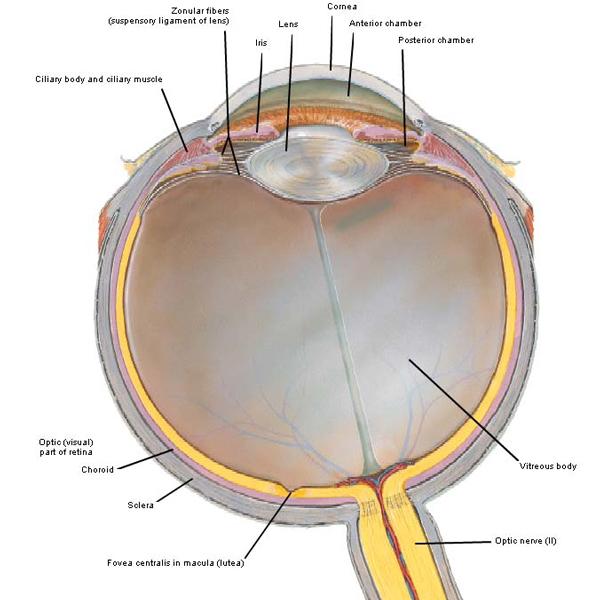
Let’s begin the lesson with a quick review. In Anatomy Lesson #31, we learned parts of the eyeball. Photo A is a horizontal section through a left eyeball (as viewed from above). The sclera is the white outer coat. The choroid is a coat of blood vessels internal to the sclera. The retina with its specialized sites is inside the choroid. The transparent cornea projects from the front surface. Iris and pupil (Anatomy Lesson #31) are behind the cornea. The biconvex lens is behind the iris. The ciliary body with its ciliary muscle forms a ring around the lens. The anterior chamber is a space between cornea and iris that is filled with the watery aqueous humor. A space between iris and lens is the poorly named posterior chamber which is also filled with aqueous humor. Behind the lens is the largest space of the eyeball, the vitreous chamber containing vitreous humor or vitreous body.

Figure0083-a-KLS-editede

Photo A

NOTE: this lesson shows images of the eyeball in horizontal section oriented with the cornea directed upward (Photo A) or rotated 90° so the cornea faces left or right (Photo C). Don’t be distressed when you see this flip flop; it just reflects preference by the creator of the image.

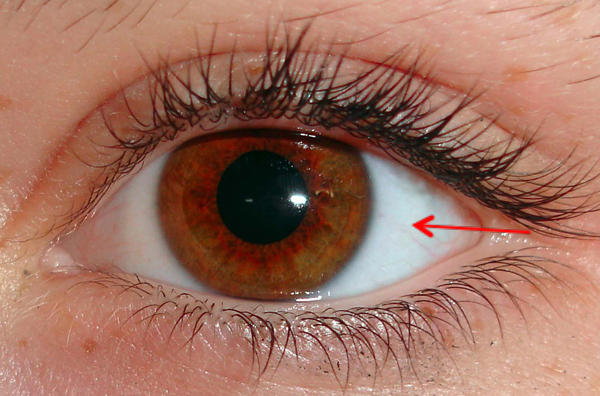
This lesson will cover sclera, cornea and lens. The sclera is the tough, white outer fibrous coat of the eyeball (Photo B – red arrow); it provides shape and resistance as well as attachment for extraocular muscles (Anatomy Lesson #30) and some intraocular muscles (Anatomy Lesson #31). The tiny red blood vessels seen in Photo B are actually located in the bulbar conjunctiva (Anatomy Lesson #30) which adheres to the anterior sclera.

Hazel-Eye-Morguefile2-KLS-edited

Photo B

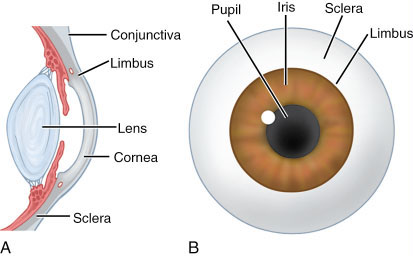
The cornea (Latin meaning horn) is a transparent dome covering the anterior 1/6 of the globe. It bulges because its radius is smaller than that of the remaining eyeball. This creates a small sulcus (groove) at the corneoscleral junction known as the limbus (Latin meaning edge or border; Photo C).

Try this: Ask a partner to sit while you look at one of their eyes from a side view. Identify the white sclera. Find the transparent cornea bulging from the front of the eyeball. Find the limbus, the groove where cornea and sclera meet.

862

Photo C

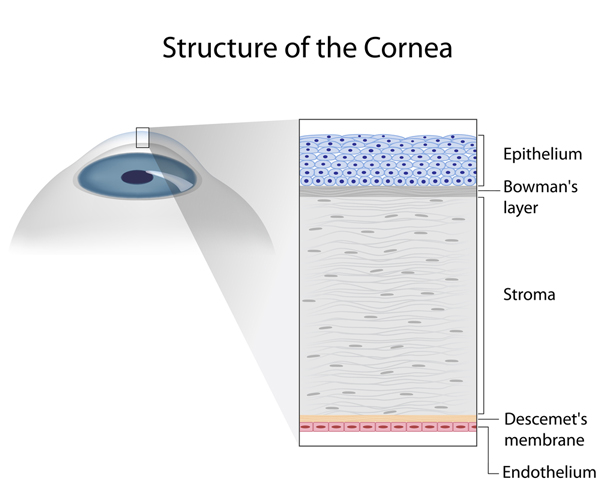
The cornea is a truly fascinating part of the eye being composed of cells and extracellular molecules arranged in five microscopic layers (Photo D). With the exception of the stroma or middle layer, the names of the other layers don’t concern us today. A normal cornea is transparent because the stroma is made of regularly arranged layers of collagen molecules and because it lacks blood vessels.

Question: if it has no blood supply, how does it get oxygen and nutrients?

Answer: these are delivered to the superficial cornea by the tear film and to the deep cornea by aqueous humor (or humour). The cornea is well-equipped with pain fibers as anyone knows who has injured it. And, as you realize, if the cornea is touched an automatic reflex is evoked that closes the eyelid for protection.

shutterstock_127500686

Photo D

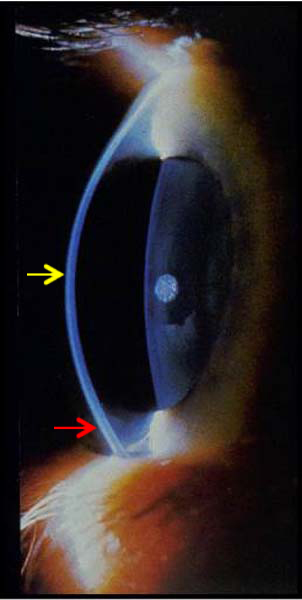
The cornea is not of the same thickness throughout: it is thinnest at its middle (~0.5 mm) and thickest near its rim (~0.8 mm). This change in thickness is clearly evident in this magnificent image from Lesson #31 (Photo E – yellow arrow at middle of lens; red arrow at rim).

Picture3-KLS-edited

Photo E

The normal cornea is smooth and clear like glass, but it is also strong and durable so it helps the eye in three ways:

  • Refracts (bends) light rays to help focus them on the retina (Photo F – black arrow).
  • Shields the eyeball from germs, dust, and other harmful matter.
  • Filters out some of the damaging ultraviolet (UV) wavelengths in sunlight.

Light rays entering the eyeball must be bent to focus them on the retina. The cornea is powerful providing roughly 2/3 of the overall refractive power of the globe. But, understand that its curvature is fixed and normally does not change.

normal%20vision%20diagram

Photo F

Corneas are subject to a variety of diseases and conditions including allergies, conjunctivitis (pink eye), infection, dryness and dystrophies (cloudiness) to name a few. A seriously damaged cornea may be injured such that light cannot penetrate the eyeball to reach the light-sensitive retina. Sometimes a corneal transplant is required wherein a surgeon removes the central portion of the cloudy cornea and replaces it with a clear cornea, usually donated through an eye bank.

Here are two pairs of clear corneas going at it eye-to-eye (Starz episode 109, The Reckoning). Look me in the corneas lass, when I’m talking to ye! I am your 18th century hubby and ye will obey me! This  Sassynach looks Jamie in the eye and while she’s at it, she’ll spit in it too! She doesn’t have to do what Jamie says. Aye ye do; If ye dinna do what I say then there’s a price ye’ll have to pay! Ouch!

ep-109-Jamie-and-Claire-cornea-KLS-edited

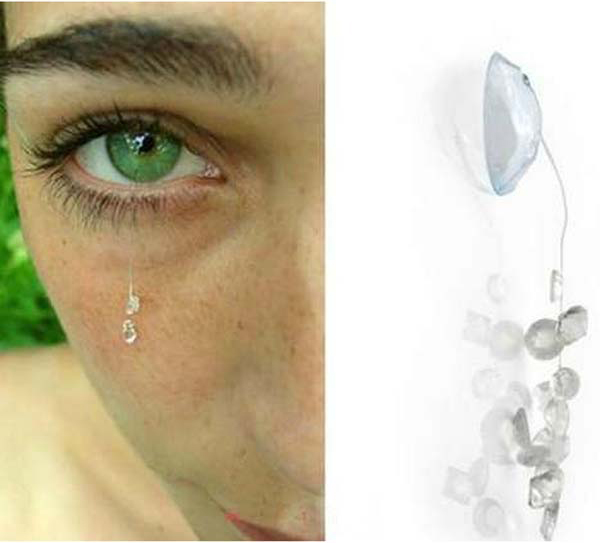
And, just when we think that we have seen it all, well, we haven’t! Have you ever heard of corneal jewelry? Yep, small crystals and other gewgaws hang via a thread from a contact-type lens! Not sure that swinging counterweight would feel very good dropping from the cornea but can’t say as I’ve never tried one.

fashion-eyeful-contact-lens-jewelry-KLS-edited

Photo G

Moving along, the lens (Latin meaning lentil) is next. The lens is a transparent, bi-convex structure suspended between iris and vitreous humor that continues to grow throughout life. The lens is shaped like a flying saucer although its front surface is flatter than its back surface (Photo H). Near the pupillary rim, the iris is in contact with the front surface of the lens but the two diverge at the sides. The back surface of the lens sits in a divot of the vitreous humor. Like the cornea, its purpose is to refract light rays to focus on the retina and is responsible for about 1/3 of the overall refractive power of the eyeball.

eye KLS edited

Photo H

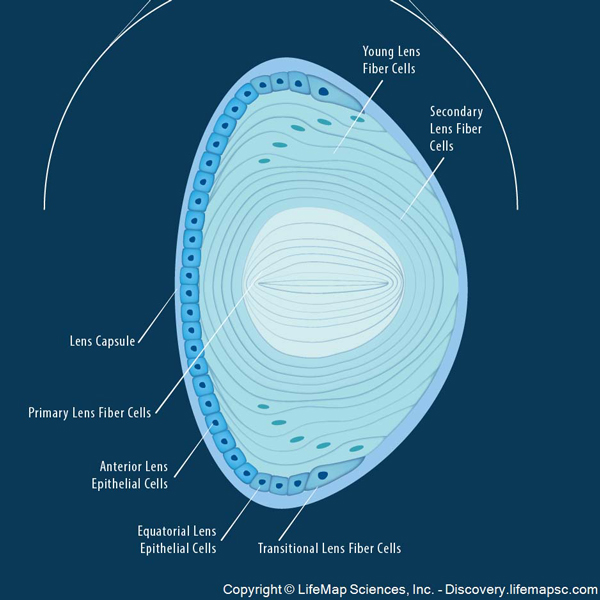
Lens structure is amazing and complex but simplified for this lesson. Like the cornea, the lens is avascular to assist with transparency. It is made of very long (12 mm) and very thin cells known as lens fibers (Photo I). These cells are arranged in layers around a central core much like the rings of an onion. The lens has also a capsule, some cube-shaped cells in front and a few other features but these do not concern us for this lesson.

The_Anatomy_and_Structure_of_the_Adult_Human_Lens-copy-KLS-edited

Photo I

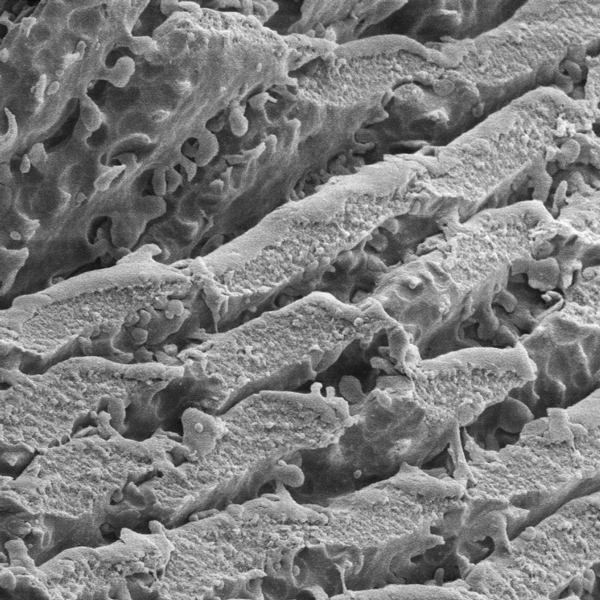
Photo J is an image of lens fibers taken with a scanning electron microscope (Anatomy Lesson #6), an instrument that takes 3-D images of microscopic structures. Very cool! With this type of microscopy, lens fibers look like tightly-packed lasagna noodles. Nuclei and other cell structures (organelles) are absent from mature lens fibers to boost transparency. Lastly, the fibers are filled with crystalin protein and their water content is very low.

fig_1_1_big-KLS-edited

Photo J

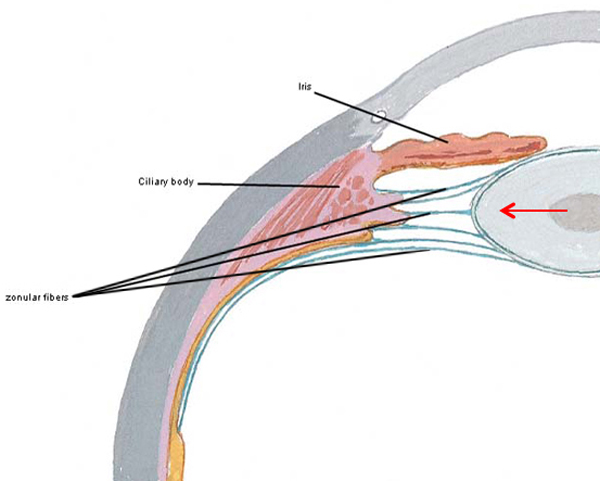
The lens is suspended from the ciliary body by a ring of fibrous strands known as zonular fibers. Although difficult to appreciate in a two dimensional image, zonular fibers attach all the way around the equator of the lens (Photo K – red arrow) much like a round trampoline pad that is suspended from a frame by its coils.

Figure0085B-KLS-edited

Photo K

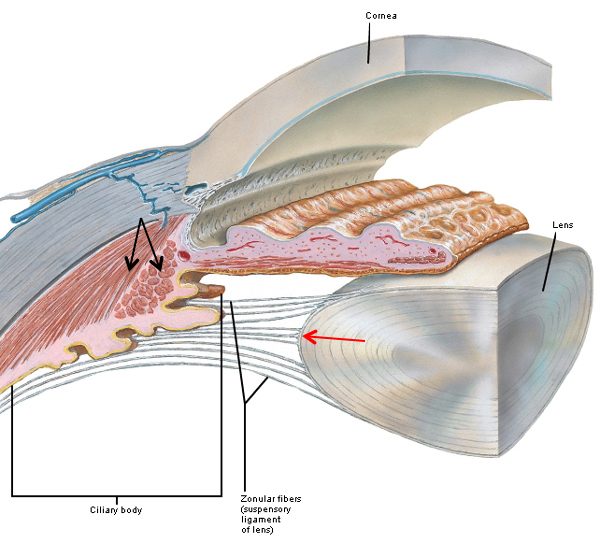
A closer look at the suspensory mechanism reveals that several layers of zonular fibers attach to the lens at various points at or near its equator (Photo L – red arrow). Collectively zonular fibers form the suspensory ligament of the lens. Another important feature, the ciliary body contains bundles of (involuntary) smooth muscle cells (Photo L – black arrows).

Figure0084-KLS-edited

Photo L

Like the cornea, the lens refracts (bends) light rays to help focus them on the retina. Unlike the cornea with its fixed curvature, the lens is flexible and its curvature can be adjusted to fine tune focus, an ability which decreases with age. Based on the distance from a viewed object, the lens flattens or fattens.

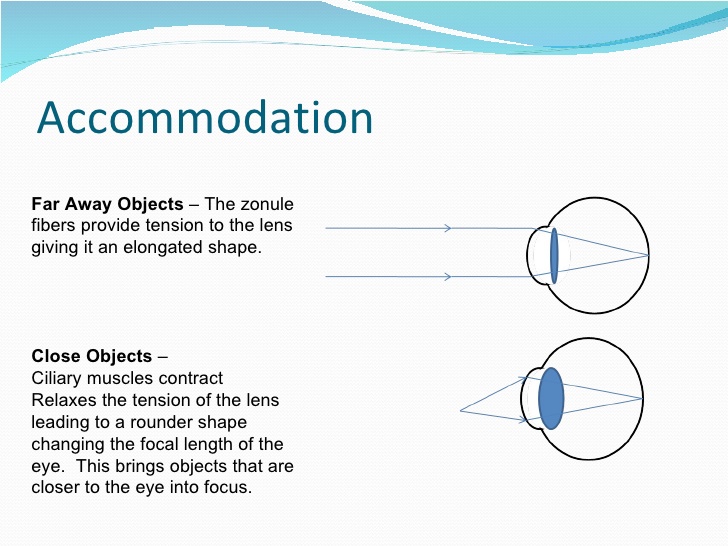
Simply put #1: light rays from far objects enter the eyeball roughly parallel (Photo M – top image) and not much lens refraction is required to focus them on the retina. With this scenario, the ciliary muscle is relaxed and the lens is flat because it is under tension by zonular fibers of the suspensory ligament.

Simply put #2: light rays from near objects (Photo M – bottom image) diverge before reaching the eye so the lens thickens to refract these rays and bring them into focus at the retina (if the lens doesn’t thicken, near light rays would come to focus behind the retina and the image would be blurry). With this scenario, ciliary muscles contract releasing tension on zonular fibers (i.e. the suspensory ligament) so the lens fattens, an action known as accommodation of the lens. Accommodation is accomplished by, yes, the parasympathetic division (PSNS) of the autonomic nervous system causing ciliary muscles to contract!

eye-anatomy-15-728

Photo M

A clarification is important here – accommodation for near vision actually involves three important changes, all of which occur automatically:

  • Eyeballs converge because both medial rectus muscles contract (Anatomy Lesson #30)
  • Pupils shrink in size because the sphincter pupillae muscles contract (Anatomy Lesson #31)
  • Lens thickens because ciliary muscles contract, releasing tension on zonular fibers and the lens assumes its natural fat state (This description may sound counterintuitive but it is correct)

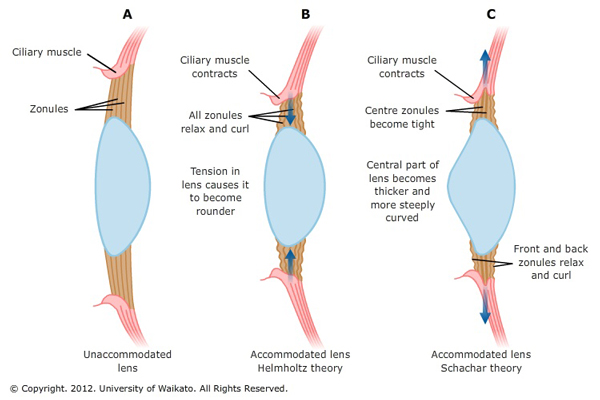
Although scientists know that lens curvature increases with near vision to ensure that the light entering the eye focuses on the retina, the way this happens is still unresolved. Photo N, left panel shows the flattened shape of the lens with far vision. The middle and right panels show two theories about the shape change of the lens during near vision/accommodation. The Helmholtz theory (1855) proposes that the ciliary muscle contracts, all zonular fibers relax and the lens thickens. The Scharchar theory (1992) suggests that the ciliary muscle contracts, selective zonular fibers relax and only the central part of the lens thickens. There is yet a third theory but too technical for today’s lesson. It has been claimed that most modern eye specialists hold with the Helmholtz theory.

Try This: Have a pal sit at one end of a room and focus on something at the far end. Now, step in front of the pal, bend down and ask him/her to look at your nose. If you do this carefully, you can see the eyeballs draw together and the pupils shrink with accommodation. You will not see the lens change shape because it lies too deeply. Try it a couple of more times with the pal looking at something over your shoulder and then at your nose to be sure you got it. This is accommodation.

Theories-of-eye-accommodation

Photo N

Claire presents us with a wonderful example of accommodation as she looks into the bonny orbs of her handsome Highland Hero (Starz episode 110, By the Pricking of My Thumbs)! Her pupils are constricted and her eyes converge to focus on the object of her desire. Thickening of her lens is not visible. Come back to her, James Fraser!

ep-110-Claire-eyes-KLS-edited

Not to be outdone, Jamie’s eyes can accommodate too (Starz episode 111, The Devil’s Mark). Ahhhh, where did ye say ye were from, Sassylass??? Pupils constricted and eyes convergent…great job, laddie!

ep-111-Jamie-eyes-KLS-edited

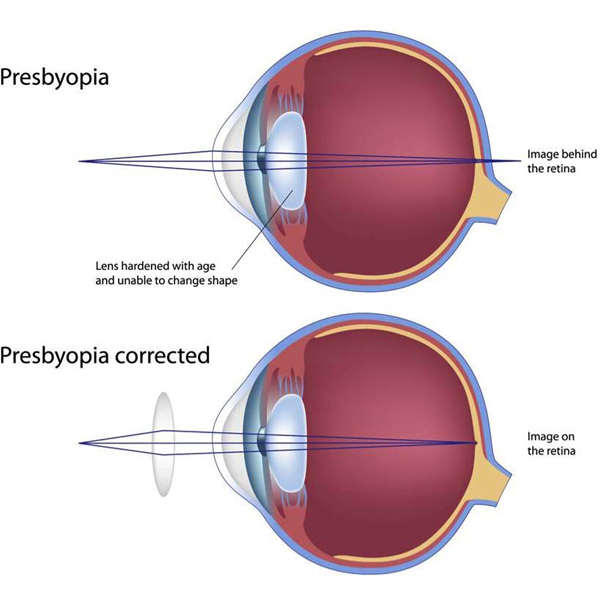
With age, the lens and ciliary muscle undergo changes. Known as presbyopia (Greek meaning old eye), the lens gradually loses its flexibility and the ciliary muscle weakens so focusing on near objects is impaired (Photo O – top image) and the image comes to focus behind the retina. Thankfully, distance vision usually remains unaffected. This condition is easily treated with eyeglasses or contact lenses (Photo O – bottom image) which refract the light rays to bring them to focus at the retina. Please note that at present, presbyopia cannot be treated effectively with surgery. Presbyopia usually becomes apparent in our early- to mid-40s, but this is actually a gradual process that often begins earlier.

presbyopia-treatment-copy-KLS-edited

Photo O

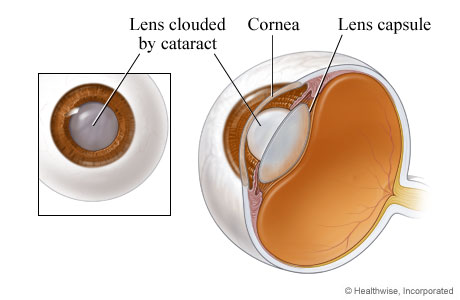
Next, let’s consider cataracts: not a torrent of water but opacities of the lens that can result in impaired vision or blindness (Photo P). Cataracts have been around for a very long time with the earliest documented case being depicted in a small wooden Egyptian statue from about 2400 B.C.E.

A cataract can occur in either or both eyes but does not spread from one eye to the other. Eye cataracts are common in older people as the aging lens and its fibers become more and more opaque, but cataracts can also form congenitally, after injury, following treatment with some medications, or from disorders such as glaucoma. A startling statistic: half of the US population 80 years old and older have cataracts or have had cataract surgery. Now days, there are several different surgical approaches to cataract treatment but they typically involve removal of the natural lens followed by implanting an artificial intraocular lens.

cataracts%203

Photo P

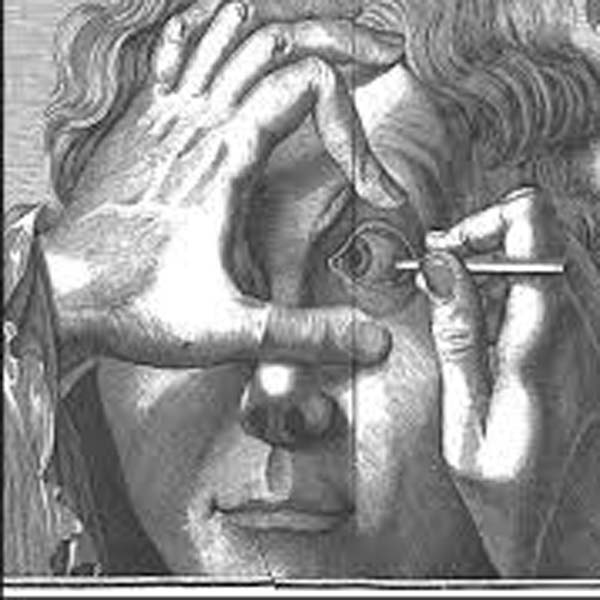
Let’s take a look at some interesting history about the cataract. It may be difficult to believe, but the earliest recorded surgical treatment of cataracts was 800 B.C.E., in India. Using a procedure known as couching, a curved needle was inserted through the coats of the eyeball. The lens was pushed downwards and backwards into the vitreous humor and out of the field of vision. Later, couching spread from India to China, Babylonia and Egypt. Centuries later, couching was practiced in Europe (Photo Q) by traveling barber-surgeons with little or no training and the procedure often left patients blind or at best with only partially restored vision. Other strange and startling treatments were also popular. Nicholas Culpeper records a cataract treatment in his School of Physick (1659):

“The head of a cat that is all black burned in a new pot or crucible, and made into fine ashes, and a little of it blown with a quill into an eye that hath a web or pearl growing in it, three times a day is a sovereign remedy”

couching cataracts copy KLS edited

Photo Q

During Outlander’s time, John Taylor (1703-1772) was the first in a long line of British oculists. Dubbing himself “Chevalier” and “Ophthalmiater Royal,” Taylor became the personal eye surgeon to King George II (Yep; same sovereign that Claire mentions to Colum in Starz episode 102, Castle Leoch), the pope, and a number of European royal families (Photo R). A colorful character who many consider a charlatan, he traveled throughout Europe in a coach painted with images of eyes to advertise his expertise. Taylor removed cataracts either by couching or breaking them up and extracting the bits and pieces. Prior to performing each surgery, he delivered to the audience (yes, groups of people often observed such surgeries) a long, grandiose self-promoting speech.

Purportedly, Taylor once confessed that he had blinded hundreds of patients. Two of Taylor’s botched cataract surgeries included famous composers George Frederic Handel (1685–1759) and Johann Sebastian Bach (1685-1750). Taylor performed couching on Handel but it was unsuccessful and the composer suffered blindness throughout his remaining years. Taylor also used couching to treat Bach’s bilateral cataracts. A week later, Bach was re-operated on but he remained blind and, weakened by the surgeries, he died four months later.

Joannes_Taylor_Medicus KLS edited

Photo R

Many of us are indeed fortunate to be able to choose good eye surgeons with superior training and expertise than those of Jamie’s time. But, I would be amiss not to note that today couching is still practiced in remote areas of third world countries. Let’s give a shout out (and a donation if possible) to those surgeons who travel to dangerous regions of the globe and often at their own expense to bring current therapies to those who are less fortunate.

Let’s close the lesson with a parting keek at Jamie as he keeks at Claire (Starz episode 102, Castle Leoch)! Herself reveals in her 8th book, Written in My Own Heart’s Blood, that Jamie often surreptitiously appraised Claire with his bonny orbs before they wed. He declares that anyone would have thought them well-suited for each other had they noticed his thorough perusal of her:

“If they’d seen the way I looked at ye, Sassenach, when ye didna see me lookin’—then, aye, they would.”

OR, to quote Rick’s famous line from Casablanca:

“Here’s looking at you kid!”

looking 5

Yum! Yum! Gah!

Next lesson will be the last one on the eye: we’ll cover the retina and its parts, nearsightedness, farsightedness and some grand experiments with our own vision. For now, let’s end with a fun poem about eyes by Mr. R! The last Anatomy Lesson to feature one of his delightful science poems was in Anatomy Lesson #24.

Eyes Poem: sense of sight

I need my eyes,
So I can see,
I don’t have 5,

poem 1

Or 1,

poem 2

Or 3…

poem 3

Just 2 eyes,
On my face,

poem 4

It seems to be,
A common place,
For eyes to sit,
On animals,
From frogs, to fish,
From bears, to gulls…

poem 5

2 eyes,
1 face,
That’s a match,
But really here’s,
A little catch…
Spiders see,
With 8 bug-eyes,
And here’s another,
Eye surprise,
Scallops have,
Most of all,

poem 6

More than 50,
Must see all!
I’ll stick with 2,
They let me see,
My 2 eyes,
Are good for me…


A deeply grateful

Outlander Anatomist

photo creds: Starz, Netter’s Atlas of Human Anatomy, 4th ed. (Photos A, K, L), Wheater’s Functional Histology, 4th edition (images of structure of eye and of retina), Outlander Anatomy collection (Photo E), www.archopht.jamanetwork.com (Photo Q – couching lenses), www.discovery.lifemapsc.com (Photo I – lens anatomy), www.en.wikipedia.org (Photos R – John Taylor), www.lasik-center.com (Photo H – lens), www.medicine.academic.ru (Photo C – limbus), www.optics.rochester.edu (Photo J – SEM of lens fibers), www.rosineyecare.com (Photo O – presbyopia), www.sciencelearn.comm.nz (Photo N – theories of accommodation), www.sciencepoems.net (-Eyes poem, Sense of Sight; Mr. R’s World of Math and Science), www.slideshare.net (Photo M – accommodation), www.timelessnaturalhealth.com (Photo B – sclera), www.toovia.com (Photo G – corneal jewelry), www.visioncarespecialists.com (Photo D – corneal structure), www.webmd.com (Photo P – cataracts), www.wynneeeyeassociates.com (Photo F – refraction of light rays by cornea)

“An Aye for an Eye – The Eye, Part 3”

jamie eating bread 3 jamie eating bread 4

We’ll get to these images and eye secks later, but isn’t this is a grand place to begin today’s Anatomy Lesson #31? An old English Proverb posits that “The eyes are the window of the soul.” Well, for today’s lesson, we will peer into these wonderful windows to learn about their structure and function.

Back in Anatomy Lesson #29, it was proposed that the eye is the most elegant and complex of our sense organs. After we consider a brief overview of eye structure, this entire lesson is devoted to the iris, a part so detailed that it requires its own lesson!

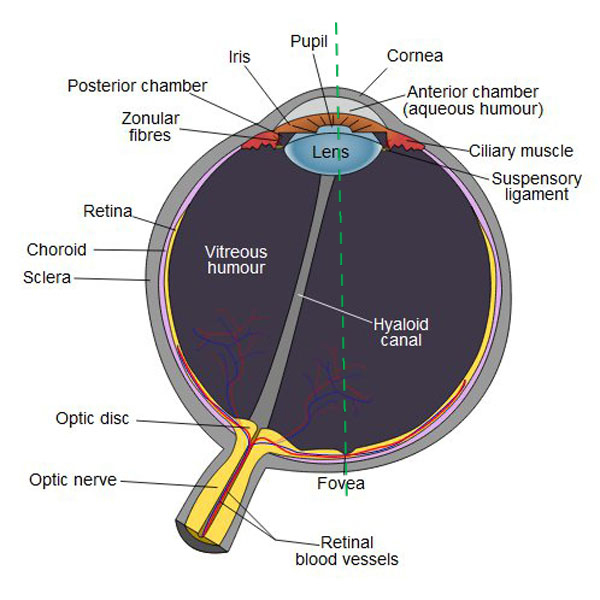
Let’s look at a “dissection” of the human eye using a horizontal section through the right eyeball (Photo A – bird’s eye view). The cornea projects from the front surface. The iris with its central opening, the pupil, lies behind the cornea. The biconvex lens is located immediately behind the iris. The red tissue near the lens is the ciliary body (labelled ciliary muscle in Photo A). The sclera is the outer fibrous coat that we see as the white of the eye. The choroid, a layer rich in blood vessels, lies internal to the sclera. The neural coat or retina lies inside the choroid. At the back of the globe are fovea, optic disc and optic nerve. The fovea, site of greatest visual acuity, lies in our visual axis (Photo A – dashed green line). The optic disc, or blind spot, is in front of the optic nerve. The optic nerve (cranial nerve II) at the back of the eyeball carries electronic impulses from the retina to vision centers in the brain. In each eye, the optic nerve angles towards the nose.
The eyeball has three chambers. The anterior chamber (Photo A, light gray crescent) is a space between cornea and iris that is filled with the watery aqueous humor. A space between iris and lens (Photo A, small dark gray area) is the posterior chamber, also filled with aqueous humor. Deep to the lens is the largest space of the eyeball, the vitreous chamber (Photo A, large dark gray area); it is filled with vitreous humor, a gel-like material.

EyeAnatomy-by-aclens.com-KLS-edited

Photo A

With the overview completed, we will consider the iris: first its structure, then its color, and finally its ability to change size.

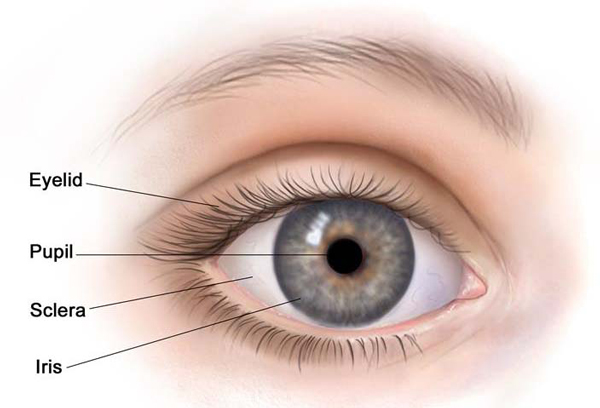
The iris is a thin circular structure deep to the cornea that has a central hole, the pupil (Photo B); think of the pupil as the absence of iris. Shaped a bit like an old-time 45-rpm record, the iris controls the diameter of the pupil and therefore the amount of light reaching the retina.

pupil-KLS-edited

Photo B

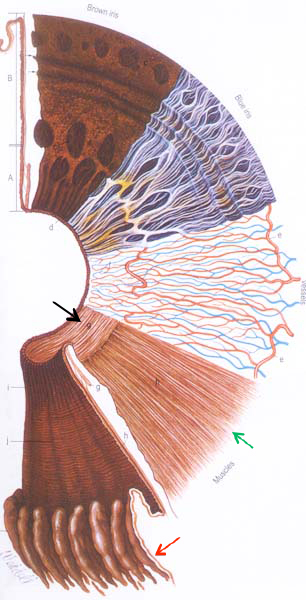
Learning the parts of the iris helps us understand its purpose. Photo C shows one-half of an iris with pie-shaped segments to illustrate different features. The iris has the following layers from front to back:

  1. Stroma and sphincter muscle
  2. Dilator muscle
  3. Posterior pigment cells

Stroma is the part of the iris that we can see: an amazing meshwork of collagen fibers, structural cells, melanocytes (Photo C – 1st and 2nd pie segments) and small blood vessels (Photo C – 3rd pie segment). The sphincter muscle is a ring of smooth muscle cells (Photo C – 4th pie segment, black arrow) surrounding the pupil.

Behind the stroma is the dilator muscle formed of specialized myoepithelial cells which contain both contractile filaments and melanin. Myoepithelial cells radiate away from the pupil much like the spokes of a wheel (Photo C – 4th pie segment, green arrow).

Posterior pigment cells contain lots of melanin and form the deepest layer (Photo C – 5th pie segment, red arrow – layer is flipped to show the back). Melanin inside the posterior pigment cells and the myoepithelial cells absorbs light rays except those admitted through the pupil. This design controls the amount of light rays reaching the retina.

iris-structure-KLS-edited-2

Photo C

Now that we have an idea of iridial (adj.) structure, let’s consider the many colors of the iris. People refer to the color of the eyes but they really mean the color of the iris. The word iris is derived from the Greek goddess, Iris, meaning rainbow. Although the iris doesn’t come in all the colors of the rainbow, its hues are quite varied.

Herself often uses iridial color to describe her beloved Outlander characters. In the Outlander book alone, we read about eyes of amber, black, blue, brilliant blue, dark blue, light blue, blueberry, brown, liquid brown, cornflower, gold, golden, green, grey (English spelling), dove grey, hazel, saffron, sherry, soft blue, soft grey and yellow… What an imagination!

In the past, iridial color has sometimes presented a problem as a legitimate child was expected to have irises the same color as one or both parents. Recall how Geillis (Starz, episode 111, The Devil’s Mark) was treated at the witch trial for dabbling in the murky arts? Well, some women have faced accusations and indignities for bearing children whose irises differed in color from those of either parent. Later, science declared that iris color was a simple dominant-recessive inherited trait, e.g. brown irises dominant over blue. An old myth in human genetics is that two blue-eyed parents cannot have a brown-eyed child. Unfortunately this erroneous concept is still being taught in some genetic courses. Not so! New data has caused science to revise understanding of eye color. Iris color is now known to be a polygenetic trait with perhaps as many as 15 genes operating to determine final iris color. The genetics of eye color are so complex that almost any parent-child combination of iris colors can and does occur. Go, science!

ep-111-Geillis-02-KLS-edited

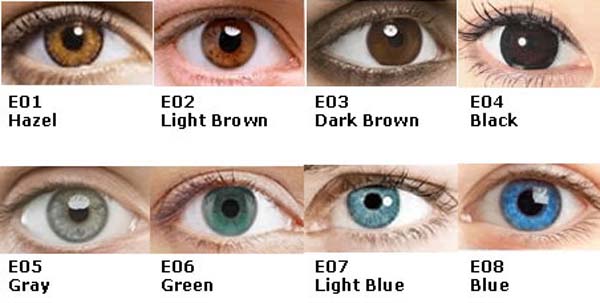
Human iris color ranges from very light blue to very dark brown. Scientists generally agree that there are at least five or six major colors plus many mixtures: hazel, brown, black (actually very dark brown), grey, green and blue (Photo D). Indeed, iris color is so diverse that charts and scales have been developed in an effort to categorize and standardize the wide spectrum of iris colors.

eye_color KLS edited

Photo D

In Anatomy Lesson #5 we learned that skin contains melanin, a pigment produced by melanocytes. Well, the iris contains melanocytes too, but the melanin is not blue, grey, hazel or green. Rather, iris melanin ranges from light brown to dark brown (eumelanin) with a wee bit of yellow to red (pheomelanin) sometimes present.

So, if irises do not contain blue, gray, green or hazel melanin, what accounts for these colors? Well, the causes are a bit complicated but four factors play a role:

  1. Melanin content in pigment epithelium and myoepithelial cells at the back of the iris: although there are slight differences, both cell types are typically heavily pigmented in all eyes (an exception is noted below). These layers absorb all the light that reaches them.
  2. Melanin content within stromal melanocytes: stromal melanin varies greatly with different iris colors (compare 1st and 2nd pie segments of Photo C). Brown or “black” irises have heavily pigmented stromal melanocytes. Blue or grey irises have little or no stromal melanin. Green irises have light brown stromal melanin or amber (see below) pigments. Hazel irises contain moderate amounts of light brown melanin.
  3. Light scattering properties of stromal collagen: these molecules scatter light rays depending on their size and density, much like water droplets in the air makes the sky appear grey.  Grey irises contain larger collagen deposits that scatter light in this manner.
  4. Light scatter properties of stromal turbidity: This is a fancy way of saying pigments and other stromal molecules also scatter light but in a different way: long wave light is absorbed and short wave light is reflected back towards the viewer. This effect is similar to a type of light scattering that causes the sky to appear blue (it isn’t) and occurs is blue, hazel and green eyes.

An exception to the above occurs in a true albino who lacks all iridial pigment so the iris appears red from its blood supply (Photo C, 3rd pie section).

Now, let’s consider some iris colors from Outlander characters. Here is wee winsome Willie with his big beautiful brown irises. He informs Claire that Jamie has always helped him so he will help rescue Jamie from Wentworth Prison (Starz episode 114, The Search). But, mayhap he carries a soft spot in his heart for Claire? Show him the way lassie! Willie has oodles and oodles of dark melanin in the stromata (pl.) of his irises so they appear very dark brown.

ep-114-Willie-eyes-KLS-edited

DNA studies on ancient remains show that all humans once had brown eyes. They also show that blue eyes are probably the result of a genetic mutation that occurred some 6,000 to 10,000 years ago and may be the source of all blue-eyed humans alive on the planet today.

Dougal’s light blue irises inform us that there is little or no melanin in his iridial stroma (Starz episode 109, The Reckoning). Notice, however, that in some light his irises appear gray or blue-grey. Dougal is a likely candidate for the scattering effect of external light on stromal collagen explaining why his eyes sometimes appear bluer or grayer depending on lighting conditions, how much money is involved or if kissing Claire is on his mind. Either way, gie him back that bag o’ gold, Colum!

ep-109-Dougal-eyes-KLS-edited

In the Outlander books, Herself informs us that Claire has golden/amber/whisky-/sherry-colored eyes. Whew, lucky lady! Jamie remarks on Claire’s unusual eyes – shortly after their wedding:

The finger moved to my face, drawing from temple to cheek, smoothing the hair back behind my ear. I remained immobile under his scrutiny, trying not to move as his hand passed behind my neck, thumb gently stroking my earlobe. “Golden eyes; I’ve seen a pair like that once before—on a leopard.”

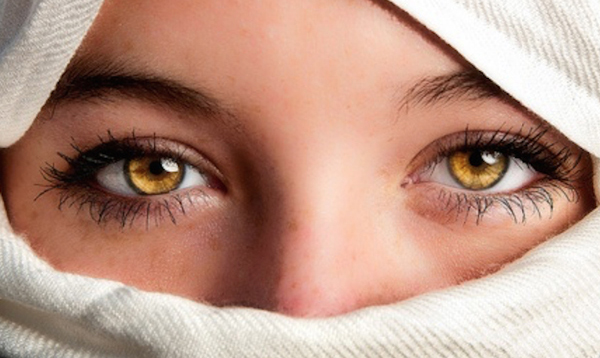
Amber eyes in humans are unusual (Photo E). Such irises are typically a solid color with strong yellow/gold or russet/copper tints. The basis for amber coloration is poorly understood but some scientists believe it is due to deposits of lipochrome. Lipochrome is not a type of melanin; rather it is an aggregation of various molecules of golden hues. Lipochrome may also account for the yellowish specks or patches in green eyes or gold tones in hazel and blue irises.

amber-eyes-RLS-edited

Photo E

Also, stromal pigmentation may not be uniform between a pair of eyes or even within one eye. There are wedges, flecks, rings and patches of varying stromal pigmentation. Consider Captain Rat-Man’s right iris as “witch-that-she-is” Claire gives him the hour of his death (Starz episode 115, Wentworth Prison). Oooh, BJR, did ye get a bit o’ bad news? Aye, he is going to pay the price for messing with her Jamie! He’s a bad man, but in this light, his lovely hazel eyes contain scattered dark brown flecks. Such flecks are sites of heavier stromal pigmentation. Out damn spot (“the Scottish play”, Act 5, Scene 1)!

ep-115-BJR-eyes-KLS-edited

Claire’s beautiful blue eyes are on full display as she presents a delightful example of a dark blue limbal ring, a site of increased light scattering at the outer rim of the iris (Starz episode 116, To Ransom A Man’s Soul). Her pupils are contracted as she inspects her beloved red-heided Highlander: whew, he hasn’t started to puke yet! Eye-love if I ever kent it! (love, love, love her hair and elegant neck!)

ep-116-Claire-eyes-02-KLS-edited-2

Can the irises change color? Well, yes, they can. For example, many babies are born with blue eyes that change color with age. Lightening or darkening of iris color has been reported during early puberty, pregnancy, and sometimes after serious trauma suggesting that chemical reactions and hormonal changes can influence iris color. A particular drug used to treat glaucoma can also increase pigmentation of the iris and a few other diseases can change iris color. Recently, a patient suffering from the Ebola virus reported that the infection turned one of his blue irises to green.

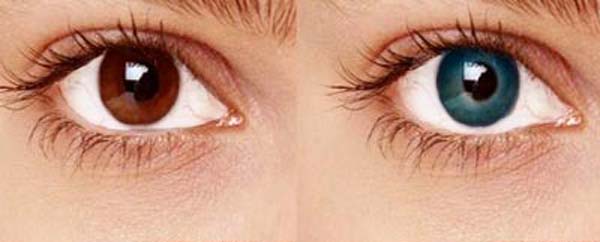
Many people consider blue irises to be a most desirable color. Pertinent to us Outlanderphiles – Scotland has the second highest rate of blue irises in the world: 50% of Scotland’s population has blue eyes and that number jumps to 86% if green eyes are included! Finally, for thrill seekers, a laser treatment is now available that changes brown irises to blue by eliminating the brown melanin of the iridial stroma (Photo F). Hopefully, readers will get thoroughly informed about side effects before opting for such a treatment.

eye-colors KLS edited

Photo F

Another interesting fact about iris color: likely, you have seen individuals with one iris a different color than its counterpart. This is heterochromia and it may be complete wherein each iris is a different color (Photo G) or partial where part of one iris is a different color. This uncommon condition can be inherited or acquired through disease or injury. Actually, quite a few actors have heterochromia. One actor, well known for roles in early spaghetti westerns, had complete heterochromia and was made to wear a contact lens on the light colored iris because producers feared negative reactions from the viewing audience! I doubt this would be a problem for today’s movie goers.

heterochromia-KLS-edited

Photo G

Ok, done with iris color. Let’s talk about pupil size…. Question: what do an orgasm, a multiplication problem and a photo of a dead body have in common? Each induces a slight, irrepressible expansion of the pupils. Hee, hee!

How do our pupils change size? Well, this occurs because the iris is equipped with a pair of intraocular (inside the eyeball) muscles that were mentioned earlier. We do not have voluntary control over these muscles.

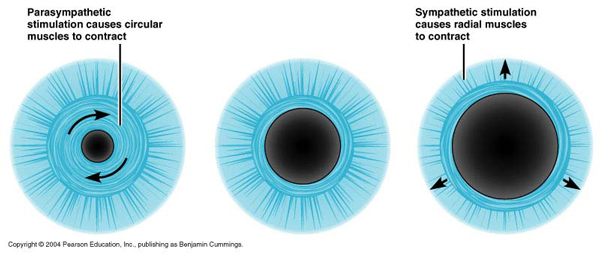
Sphincter pupillae is the smooth muscle cells that encircle the pupil. Like a sphincter, this muscle contracts to close the pupil and reduce the amount of light reaching the retina (Photo H – left image). This muscle is under control of the parasympathetic division of the autonomic nervous system; known by the acryonym PSNS, it activates in response to intense light and during rest, repose and rejuvenation.

Dilator pupillae muscle is composed of the myoepithelial cells that contain melanin pigment and muscle filaments. These are arranged radially like the spokes of a wheel (Photo H – right image). As these cells contract, the pupil enlarges to increase the amount of light reaching the retina. Dilator pupillae is under control of the sympathetic division of the autonomic nervous system; known for short as SNS, it activates in response to dim light and during fright, fight and flight responses.

NOTE: The middle panel of Photo H represents the iris and pupil with muscles at rest.

15-09_Pupil-KLS-edited

Photo H

You should know that light intensity alone is sufficient to exert major effects on pupillary diameter. Studies have shown that in very bright light, a normal pupil can shrink to a tiny 1.0 mm diameter.

“One misty, moisty morning when cloudy was the weather,” they meet Hugh Munroe amid the rain and heather. This day looks very misty and cold! Nevertheless, the light intensity is sufficient to shrink Claire’s lovely pupils as she shares bread and cheese with her new hubby and arrow deflector (Starz, episode 108, Both Sides Now)!

ep-108-Claire-pupils-KLS-edited

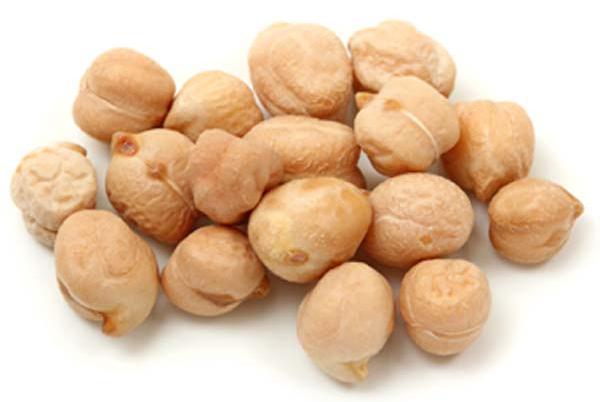
Such studies also show that with very dim light, the pupil can enlarge to 8.0 mm – roughly the size of a chickpea (Photo I – garbanzo bean)!

chickpea-seeds-KLS-edited

Photo I

Light rays aren’t the only stimuli that affect pupillary size: some years ago, a Princeton psychologist showed that pupil size increases in proportion to the difficulty of an assigned task (i.e. stress or challenge): multiply nine times 13 and the pupils dilated slightly. Calculate 29 times 13 and they widened further and remained dilated until subjects found the answer or stopped trying. In a related experiment, subjects were required to recite a series of seven digits from recall; their pupils enlarged steadily as the numbers were presented one by one and shrunk steadily as they unloaded the digits from memory. Ergo, our pupils reflect exposure to stress and mental effort.

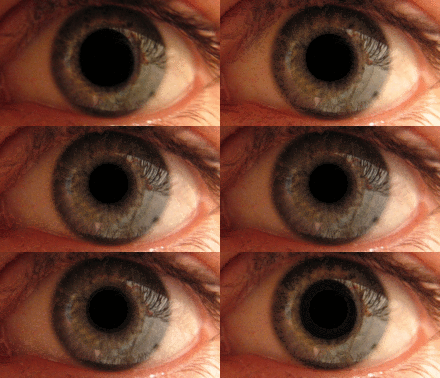
In summary, pupils constrict in response PSNS stimulus and excessive light but also prior to REM sleep and by conditioning stimuli. Pupils dilate in response to SNS stimulation and low light and also with sexual stimulation, mental challenge, some CNS psychoactive drugs and conditioning to a particular stimulus.

Eye_dilate

We’ve known from the get-go that Jamie’s pupils can dilate verra well. Anatomy Lesson #2 described his pupillary response when “Not-A-Wet-Nurse” Claire reduces his dislocated shoulder (Starz episode 101, Sassenach). That lesson explains how his dilated pupils were consistent with the SNS-induced fright, flight and fight response. Och, lassie, that hurt!

ep-101-Jamie-eyes-KLS-edited

But then, along comes Starz episode 116 (To Ransom a Man’s Soul) and whoa! This episode generated lots of on-line chatter as some fans posited that there was no way Jamie’s iris could dilate to the degree shown without the aid of CGI, dilating medications or contact lenses.

ep-115-Jamie-eyes-KLS-edited

Well, remember, given low light alone, they can dilate to the size of a chickpea. Add to that the stressing and depressing back-licking antics by BJR and the pupil dilates even more! Talk about fight, fright and flight! I argued for natural dilation but despite my efforts, the explanation was met with skepticism so I asked “Jamie.” To my delight he responded from a span of 202 years, that indeed his dilated pupils were unaided by anything (except the creepy crawly circumstances and very low dungeon lighting – my words)! Kudos to his fantastic acting skills!

Screen Shot 2015-05-25 at 4.44.19 PM

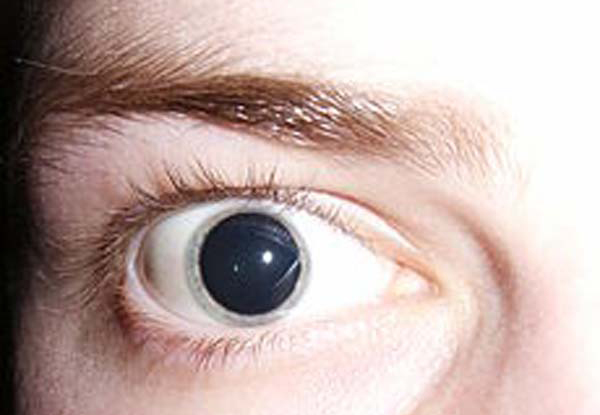
Back to pupil dilation: just how large can the pupil dilate? More than 8 mm if dilating drops are applied! You can see in Photo J, that with such medications, the iris is reduced to a very thin rim completely dominated by the pupillary opening.


artificially-dilated-pupils-KLS-edited

Photo J

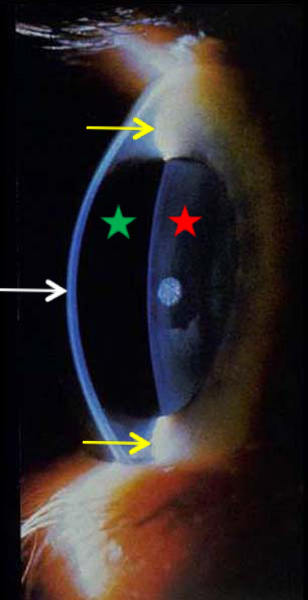
Would you like to see another view of the pupil after drug-induced dilation? Take a wee keek at this next amazing image (Photo K)! The narrow vertical slice of light running down the surface of eyelids and eye is from a slit lamp. The beautiful arc of cornea (Photo K – white arrow) bulges from the anterior surface of the eyeball. Deep to the cornea is the dark anterior chamber (Photo K: green star). Yellow arrows mark the rim of the iris; its tissues actually fold back during pupil dilation. The red star marks the convex anterior surface of the lens. Generally speaking, dilating medications paralyze the sphincter pupillae allowing the dilator pupillae muscle to contract unopposed.

cornea-KLS-edited

Photo K

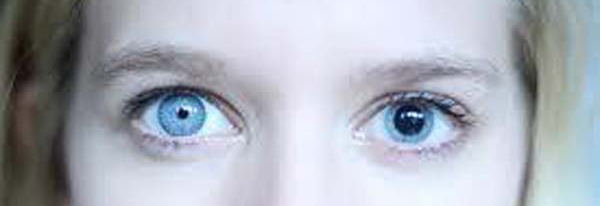
Like other body parts, the iris has diseases and disabilities, but there are too many to cover in this lesson. One point worth mentioning: in general, both pupils should be very nearly the same size. Slight variations in pupil size can be normal, but if you notice a sudden and significant difference between the size of both irises, known as anisocoria, then you should see a specialist to rule out significant medical issues (Photo L).

Anisocoria-KLS-edited

Photo L

The iris is endlessly entertaining because it is a body part we can readily see and appreciate. But, it is time to close this session. What better way than to praise the best blue eyes ever with a little more eye secks and an Ode to Sawny Blue Eyes!

jamie eating bread jamie eating bread 2

Ode to Sawny Blue Eyes

I may be a dutter,

Or even a nutter,

Embroiled in a true-stew.

It makes us all mutter

And then start to stutter,

As brilliant orbs come into view.

Bread swiped with butter

Sets hearts all aflutter,

Wit’ big eyes of bonny blue!

Thoughts in a clutter

Spitter and sputter,

What in the world shall we do?

With our minds in the gutter

Together we utter

“Gie that fab-lad his just due!”

A deeply grateful,

Outlander Anatomist.

photo creds: Starz, Grey’s Anatomy, 39th edition (Photo C), Orgasm joke from 2012 Scientific American, Outlander Anatomy collection (Photo K), www.aclens.com (Photo A), www.apsubiology.org (Photo K), www.cancer.gov (Photo B), www.enwikipedia.org (Photo M), www.imgbuddy.com (Photo E), www.memrise.com (Photo H), www.nataliacoretraining.com (Photo I), www.9gag.com (Photo L), www.pinterest.com (Photo G), www.pitchengine.com (Photo H), www.sites.psu.edu (Photo F), www.talks.fredite.com (Photo D), www.en.wikipedia.org (Photo J; gif of pupillary reflex), Jamie eating bread http://henricavyll.tumblr.com