Mini Anatomy Lesson: Claire’s Beating Heart


Greetings all anatomy students. There has been a dry spell of lessons this summer while I attended to blueberry crops and fruit trees! Berries are now done for the year and time to return to Outlander. Yay!

So, let’s get right to it.

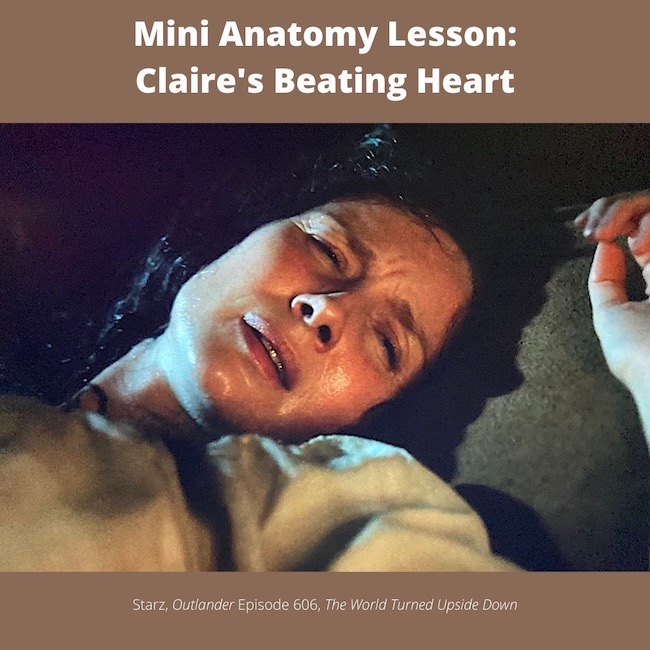
During Episode 606, The World Turned Upside Down, Claire becomes deathly ill, not from what ails the MacNiel family, but from Malva Christie poisoning! 😈 😳

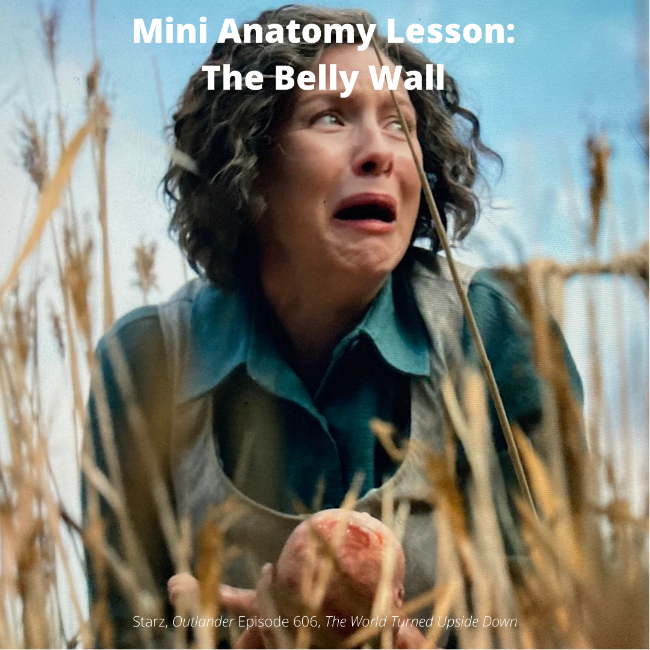
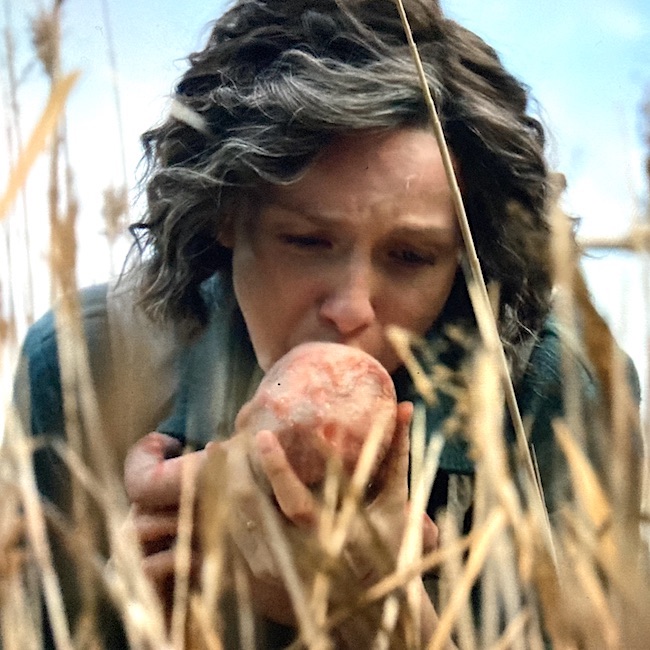
During an intense fever dream, Claire has a vision of roiling clouds and an amoeba. But then, her hands cradle something red and pulsing –  her beating heart in this startling and somewhat gruesome image: 
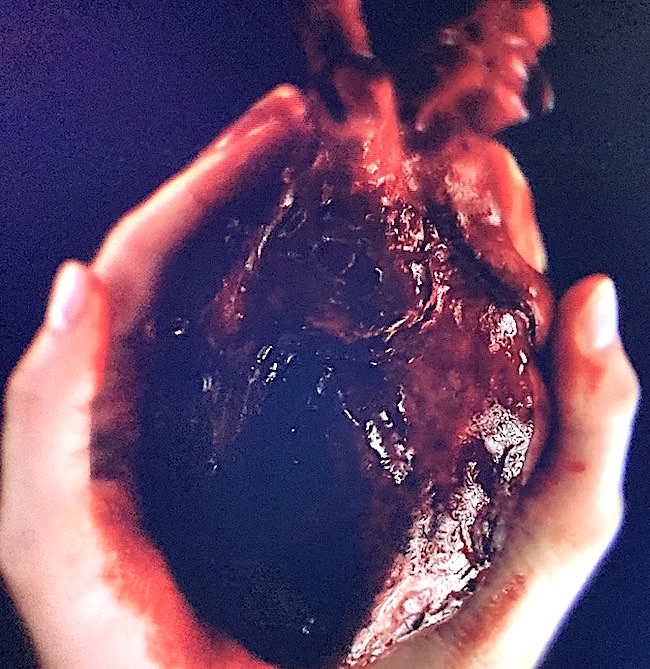
Fortunately, the show’s FX provides me with a splendid opportunity to teach students about the heart, a complex and essential organ. Oh, goodie! 😜

Learn: So, let’s study the heart!

This Mini Lesson will cover heart size, shape, position, apex, base, chambers, valves, cardiac muscle, and blood flow.  Because the heart is fairly complex, I will try to keep the explanations as compact and useful as possible. đŸ€“

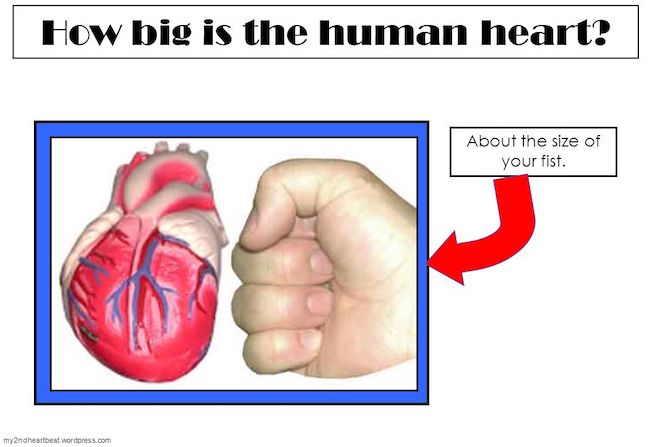
Size: First, how big is the human heart? The human heart is roughly the size of the person’s closed fist. âœŠđŸ»Â Thus, a man’s heart is usually slightly larger than a woman’s and both are larger than a child’s. 

Try This: Make a fist and take a keek at it. It is likely close to the size of your own heart. If you are female, ask a male family member or friend to make a fist and explain what it means. Ditto for a child in your life.

Fun Fact #1:  We sometimes compliment a generous person saying they having a “big heart.” But this is just a figure of speech. One doesn’t really want a big heart because a smaller heart is usually a healthier heart.  Interestingly, people who exercise regularly tend to have smaller hearts that beat more efficiently. However, recent studies show some premier athletes who vigorously engage in prolonged exercise may have a slight enlargement of the heart muscle, but this is a somewhat unique situation.
Shape: What shape is the heart? I think it is worth while to point out that the heart is not shaped like a Valentine! 😉 Overall, its shape is so complex it is a bit challenging to explain. But, let me give it a try.

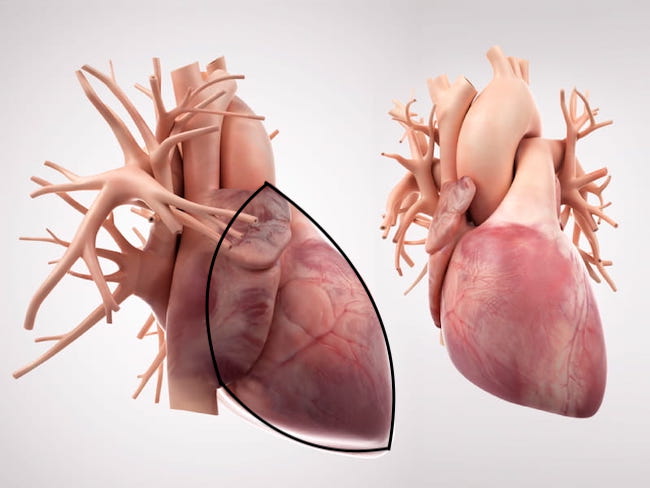
Alrighty then. If the heart is NOT shaped like a Valentine, what is its shape? Turns out, the heart is shaped something like a squat, plump hand iron without a handle! Yep. đŸ‘đŸ»

Here it is from a frontal view.  The heart is outlined in black. It is a bit difficult to visualize because the heart is somewhat obscured by the many vessels leading to and from it.  (The right view shows the heart from behind)
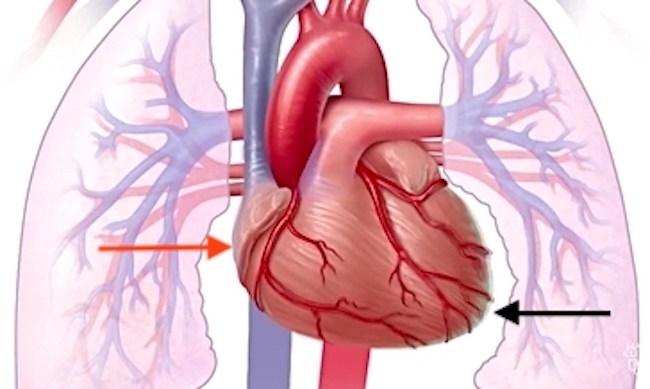
Position: Now, exactly where does the heart reside in the body? It sits in the chest nestled between right and left lungs and just above the respiratory diaphragm (black line in next figure).

About 2/3 the heart lies behind the sternum (breast bone) and about 1/3 projects to the left of the sternum with a wee bit to the right.
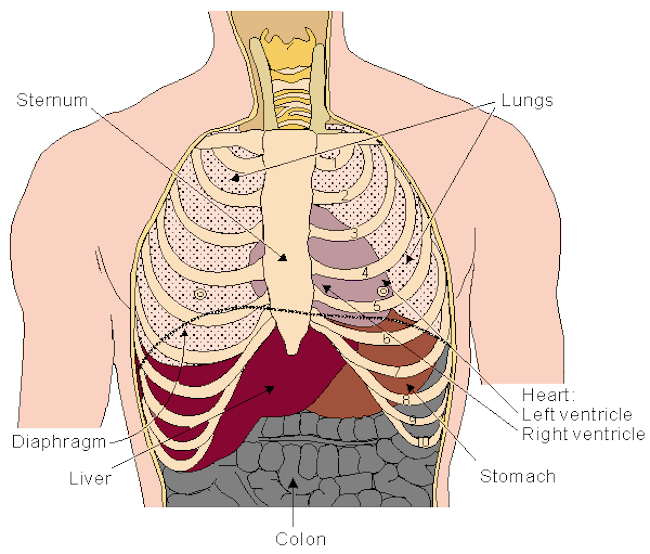
The heart does have a point but it is not directed downward as seen in Episode 606 (and many other films), but toward a person’s left side – bear in mind the hand iron image! 

Apex: The point of the heart is its apex. The apex lies at the 5th intercostal space (between the 5th and 6th ribs), a little below the nipple (but, only if the breast is high). It is nearer the rib cage than the rest of the heart making the 5th intercostal space an important landmark for hearing the heart beat.

Base: The heart has a base but it is not the surface nearest the diaphragm, as one might expect.  Rather, the base is opposite the apex and lies nearer the right lung. 
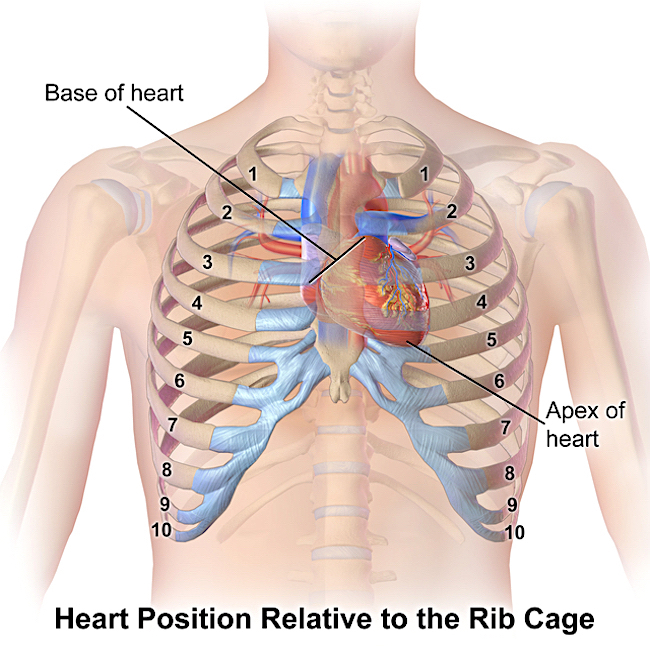
 

Next is a closer view of the heart nestled between left and right lungs (shown in pale pink). The black arrow marks the apex of the heart and the red arrow marks its base.  Notice there is a distinct notch in the left lung to accommodate the apex; this is the cardiac notch. Again, the respiratory diaphragm is not shown in the image, but it lies directly under the heart.  
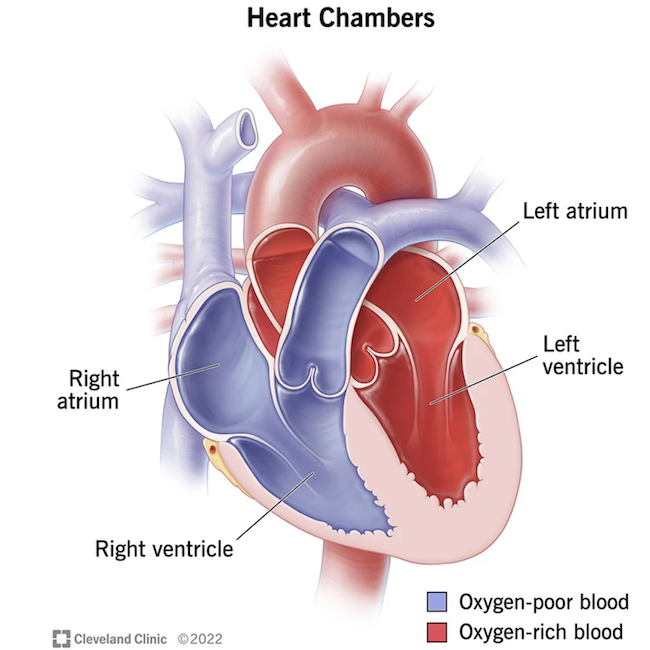
Chambers:  The human heart is divided into four chambers, each designed to receive blood. Two smaller chambers that form the base are the atria (pleural of atrium). The ventricles are two larger chambers that form the apex and sides of the heart. These chambers are named: right (R) and left (L) atria and R and L ventricles; each plays a unique role.

In the cut-away view below, we see all four chambers. Notice these are on opposite sides than the viewer’s heart because the image is designed for a health care practitioner viewing the heart of a patient. đŸ€’

In digital images, the chambers are usually color-coded. R atrium and R ventricle are blue whereas L atrium and L ventricle are red. This color designation indicates oxygen levels of the blood in each chamber. 

Bottom Line: The R two chambers are blue meaning they contain oxygen-poor blood that has just returned from the body (head, limbs, trunk). The L two chambers are red indicating they contain oxygen-rich blood that has just returned from right and left lungs.
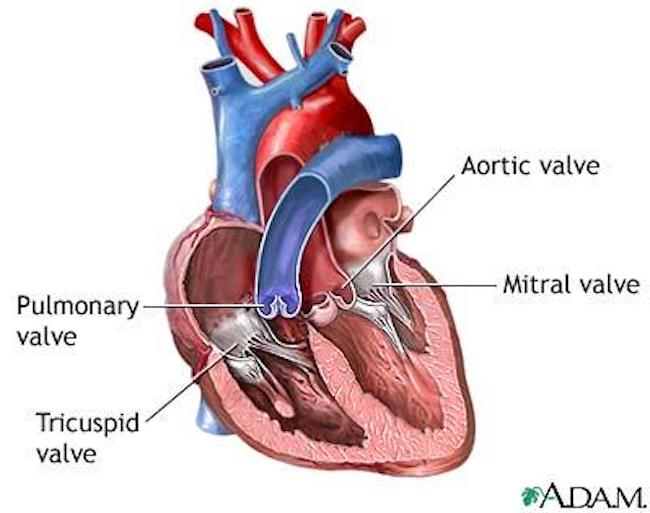
Valves: The heart is also equipped with four valves which control the flow of blood passing through the chambers. If a valve is open, the blood flows through it. If a valve is closed, then blood cannot back flow. đŸš«

The four valves are (next image):

    • Tricuspid Valve: This valve has three flaps and lies between R atrium and R ventricle. 
    • Mitral (Bicuspid) Valve: This valve has two flaps and lies between L atrium and L ventricle.
    • Pulmonary Valve: This valve has three pockets and lies between R ventricle and pulmonary artery (leading to the lungs).
    • Aortic Valve: This valve has three pockets and lies between left ventricle and aorta (carries blood to the head, limbs and trunk).

Cardiac Muscle: Just a note about heart (cardiac) muscle. Cardiac muscle is a special tissue only found in the heart. It has the ability to contract. It is thicker in the ventricles and thinner in the atria because the ventricles work harder to pump blood through the lungs and the body. The atria have thinner walls because their lighter workload consists of moving blood into their respective ventricles. Impulses from specialized cells stimulate cardiac muscle to rhythmically contract. We call this cycle of contraction and relaxation, the heart beat or cardic cycle.
 

OK, this ends the basic anatomy (although, there is much more). So let’s look as how the heart works.

Blood Flow: The heart is a pump. Similar to a pump that pushes water through a hose, the heart contracts rhythmically to pump blood through our vessels. As long as the heart continues to pump, blood continues to flow, delivering life-giving oxygen and nutrients to tissues and cells and removing carbon dioxide and waste products. 

Our hearts only work if our vessels form a continuous loop. If a vessel is cut or disrupted, then blood seeps through the opening; if blood loss is significant, then pressure falls and the heart can no longer pump normally. This explains why injury of a major vessel must be cared for ASAP.

FUN FACT #2: The human body contains some 60,000 miles of blood vessels – enough to encircle the earth 2.5 times! The heart works hard to pump blood through this vast network. 

FUN FACT #3: Each day the average heart beats 100,000+ times and pumps about 2,000 gallons of blood. In a 70-year lifetime, an average human heart beats more than 2.5 billion times! Super star! đŸ€©

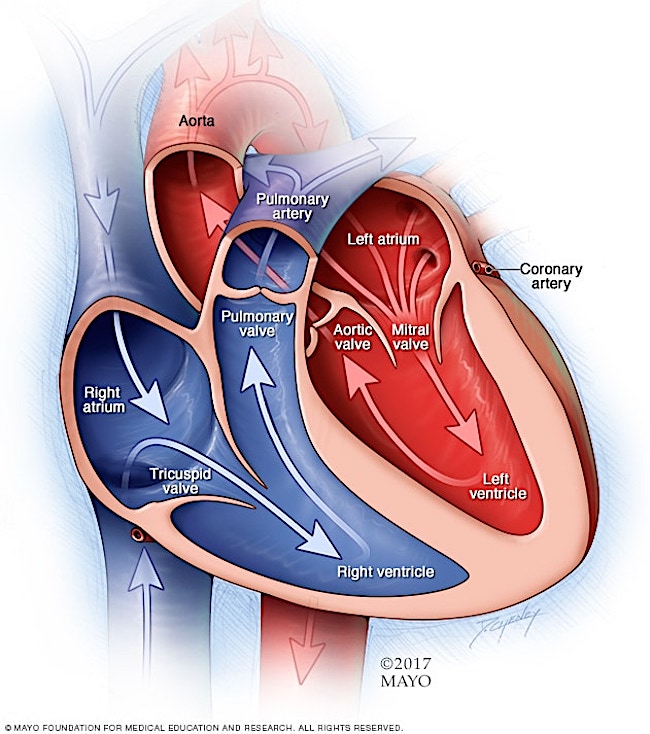
How it Works: The heart is designed to receive blood via its atria and deliver blood via its ventricles (see image below). There really isn’t a simple way to describe this complex process but let’s give it a go! đŸ‘đŸ»

    • R Atrium: Oxygen-poor blood from the body is delivered to the  R atrium via two large vessels (superior and inferior vena cavae). The R atrium contracts, the tricuspid valve opens, and blood pours from R atrium into R ventricle.
    • R Ventricle: The R ventricle contracts, the tricuspid valve closes, and blood exits through the pulmonary valve into the pulmonary artery whose branches deliver blood to R and L lungs (where it rids itself of carbon dioxide and picks up oxygen).
    • L Atrium: Oxygen-rich blood from the lungs is delivered to the left atrium by pulmonary veins. The L atrium contracts, the mitral valve opens, and blood pours from L atrium into L ventricle.
    • L Ventricle: The L ventricle contracts, the mitral valve closes, and blood exits through the aortic valve into the aorta whose branches deliver oxygen-rich blood to the body.
Cardiac Cycle: Now that you know what each side of the heart does, let’s see how the sides work together. Keeping in mind what each chamber does, understand that both atria contract simultaneously followed by both ventricles. The span of one heart beat to the next is the cardiac cycle.

Lub-Dub: The heart beat is described in anatomy and medicine as a lub-dub sound. Lub-dub sounds are close together followed by a brief pause. These sounds are caused by blood striking closed valve flaps.

    • Lub sound is caused by blood striking tricuspid and mitral valves as they close, simultaneously.
    • Dub sound is created by blood striking pulmonary and aortic valves as they close,  simultaneously.

This video offers a good representation of the cardiac cycle. Watch for the contraction of atria and ventricles and then the pause.  Also, watch valve flaps open and close as the heart chambers contract. In this animated film, only the cardiac vessels, which bring blood to and remove blood from the heart, are color-coded blue and red.

 https://youtu.be/ebzbKa32kuk

Try This: If you have a stethoscope, place it under the left fifth rib, in line with the nipple and listen for the lub-dub sounds. If you don’t have this tool, ask a partner or your child to lay down and place your ear in the same spot and try to hear the sounds of the valves closing. This is a totally awesome experience, especially if you know what it means! 

This animated video helps us to further understand the cardiac cycle –  you know the trope, “a picture is worth a thousand words.”

Fun Fact #4:  I suspect you all know that heart disease is the leading cause of death in men AND women, worldwide. But, recently it has been found that some Old Order Amish people have a rare genetic mutation which reduces the risk of heart disease by 35%! The gene has been duplicated in mice. Efforts are now underway to produce a drug that may reduce heart disease in the same way as the gene mutation. Let’s hope it works! đŸ€žđŸ»

I hope now you have a better understanding of and appreciation for your own heart. We sort of take it for granted that hearts will always be there working for us. But, the heart is susceptible to disease and is not an easy organ to understand. Its embryology is even more complex which accounts for the frequency of cardiac birth defects. You did well, though. Keep up the good work! 

Whew!  😅

Read about Claire’s beating heart in Diana’s sixth big book, “A Breath of Snow and Ashes.” This passage vividly describes her wild fever dreams as her body battles the infection planted by Malva. In Claire’s dream, her heart is the main character!

I seldom knew whether my eyes were open or closed, nor whether I woke or slept. I saw nothing but a roiling gray, turbulent and shot with red. The redness pulsed in veins and patches, shrouded in the cloud. I seized upon one crimson vein and followed its path, clinging to the track of its sullen glow amid the buffeting of thunder. The thunder grew louder as I penetrated deeper and deeper into the murk that boiled around me, becoming hideously regular, like the beating of a kettledrum, so that my ears rang with it, and I felt myself a hollow skin, tight-stretched, vibrating with each crash of sound. 

The source of it was now before me, throbbing so loudly that I felt I must shout, only to hear some other sound—but though I felt my lips draw back and my throat swell with effort, I heard nothing but the pounding. In desperation, I thrust my hands—if they were my hands—through the misty gray and seized some warm, moist object, very slippery, that throbbed, convulsing in my hands. 

I looked down and knew it all at once to be my own heart. 

I dropped it in horror, and it crawled away in a trail of reddish slime, shuddering with effort, the valves all opening and closing like the mouths of suffocating fish, each popping open with a hollow click, closing again with a small, meaty thud. đŸ€Ż

See Claire’s beating heart in Outlander Episode 606, “The World Turned Upside Down.”

Let’s all hope our hearts continue to serve us as long as possible. From my heart to yours! ♄

The deeply grateful,

Outlander Anatomist

Follow me on:

Photo and Video Credits: Starz, Sony, Outlander Anatomy, www.arcreativemedia.com,  www.bemfi.fi, www.commons.wikimedia.org, www.covenanthealth.com, www.en.wikipedia.org, garmentsteamerguide.com, www.heart.org, www.heartsearch.org.uk, www.Luxsontube.com, www.medlineplus.gov, www.slideplayer.com  
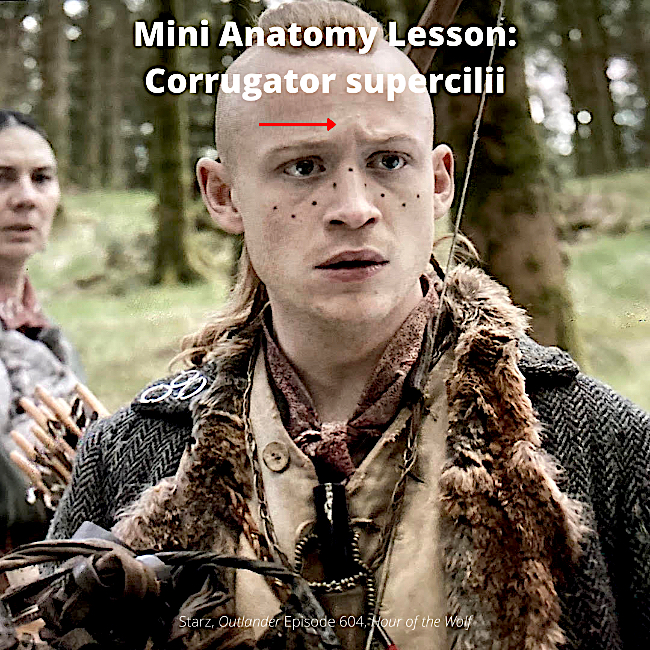
 

Mini Anatomy Lesson: Corrugator Supercilii


Anatomy Def: Paired muscles of facial expression.

Outlander Def: Ian’s worry lines when he learns he must leave his beloved Emily! 😱

Don’t know about you, but for me, John Bell’s performance in Outlander episode 604, Hour of the Wolf was flawless. His facial expressions perfectly mirrored the stress roiling in his personal life.

Facial Expression: Humans enjoy 22 pair of muscles controlling facial expression, more than any other animal, blessing us with an amazing range of emotional aspects. 

As Ian hears the Mohawk’s decision about his and Emily’s fates, the skin wrinkles between his eyebrows. How does this happen?

Corrugator Supercilii: Well, his facial expression is caused by contraction of corrugator supercilii (CS) muscles, just one of the 22 pair! đŸ˜Č

Super silly, huh? 😜

Meaning: Actually, this pair of muscles is so named because of their action and also by their placement in the face: 

    • Latin, con meaning “together” + rugare “wrinkle”
    • Latin, super meaning “over” + cilium ”eyebrow” 

Ergo, corrugator supercilii wrinkle the skin between the eyebrows.

ViolĂ ! đŸ€—

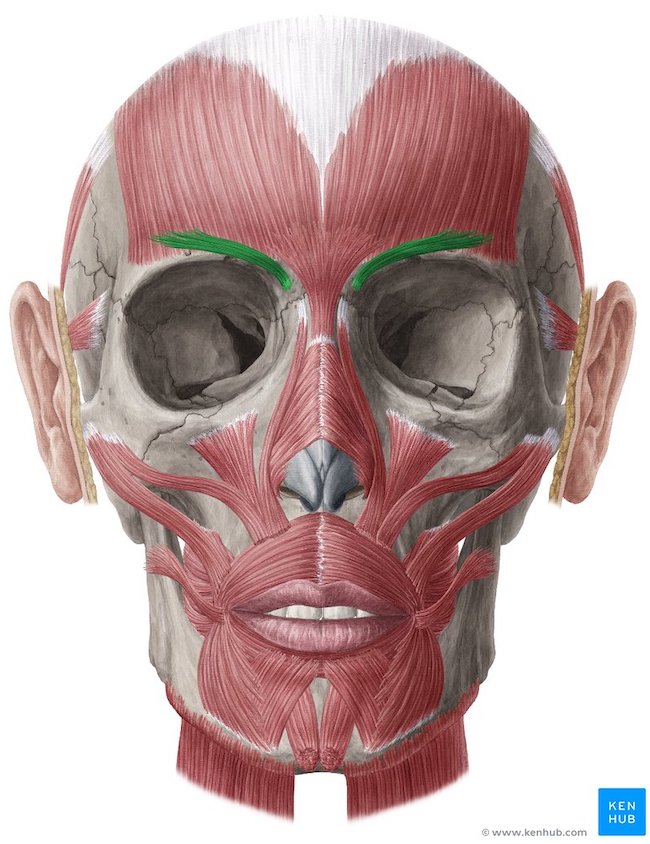
Anatomy: The figure below is a computer generated image of the paired CS shown as green slashes. CS originate from the forehead (frontal bone) about midway along each eyebrow and insert into the skin at the top of the nose (nasion). 

Function: As CS contract, the eyebrows are drawn together and downward, producing vertical wrinkles of the forehead skin.

Emotional Signal: CS belong to a group of frowning muscles, used to convey suffering! And, who does that better than our beloved Ian? 😱 

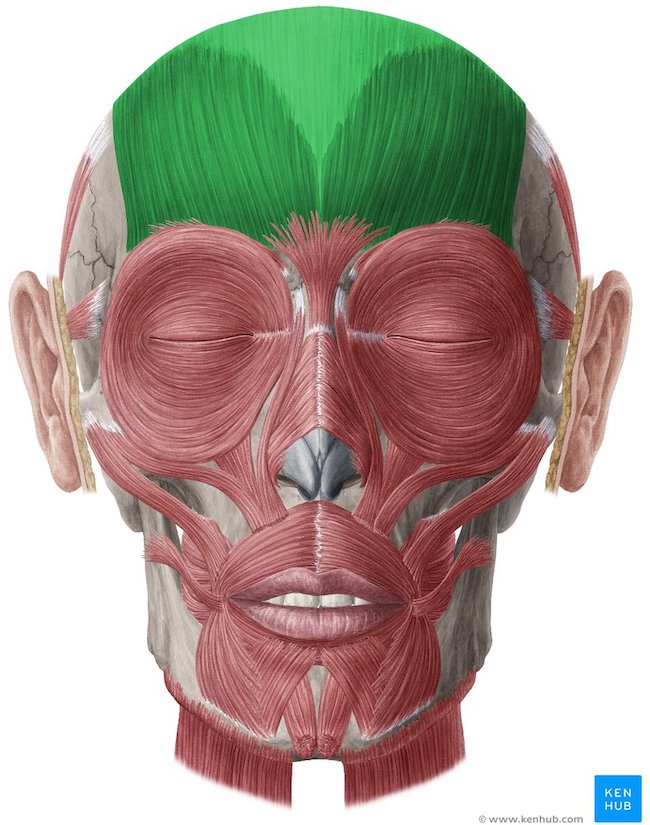
Frontalis: Just to complicate matters, let’s throw in a second pair of facial expression muscles – the frontalis. In the image below, frontalis fibers (dark green patches) run vertically through the forehead. They originate from the top of forehead (frontal) bone and insert into the skin above the eyebrows. 

Frontalis muscles raise the eyebrows and wrinkle the forehead skin but this time, the creases run horizontally. Consider Jamie in Outlander episode 606, The World Turned Upside Down. Here, a “worrit” Jamie attends to Malva’s chatter and seductive overtures.

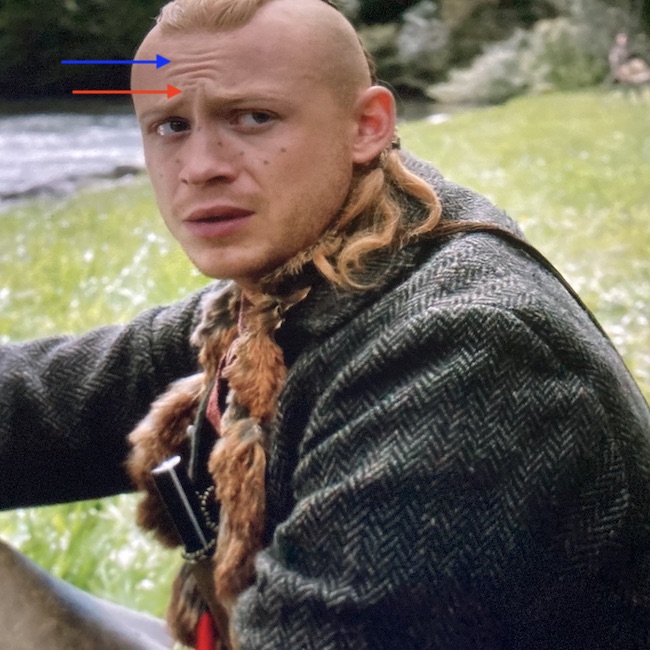
So what happens if CS and frontalis muscles contract simultaneously? Let’s look again at Ian for the answer. Deeply concerned for the wee soul of his stillborn daughter, Iseabaìl, he confides in his beloved uncle! 

Ian contracts CS (red arrow), hence the vertical wrinkles between the brows, and frontalis (blue arrow) producing horizontal wrinkles in his forehead skin. Working together, both sets of muscles truly convey worry, anguish, and despair.   

Learn much more about the muscles of facial expression in my big Anatomy Lesson #11, Jamie’s Face or Ye do it Face to Face?

Lest you think that humans are the only creatures with muscles of facial expression, meet my year-old Vizsla puppy, Finnegan. Check out the wrinkles between his “brows”? 

Studies suggest dogs lack CS muscles but other facial muscles perform a similar function. Such muscles give them what is known as pedomorphic facial features (infant-like). Humans apparently prefer such features in domesticated dogs. đŸ„°

See Ian’s worry muscles in Outlander Episode 604, Hour of the Wolf.

Read about Ian’s distress in Diana Gabaldon’s sixth big book, A Breath of Snow and Ashes wherein, it is Brianna that comforts Ian:

“Aye, maybe. But 
” He closed his eyes, hands clenched hard into fists on his thighs. “Where is she, then?” he whispered, and she could see tears trembling on his lashes. “The others—they were never born; God will have them in His hand. But wee Iseabaìl—she’ll not be in heaven, will she? I canna bear the thought that she—that she might be 
 lost, somewhere. Wandering.”

“Ian 
”

“I hear her, greeting. In the night.” His breath was coming in deep, sobbing gasps. “I canna help, I canna find her!”

“Ian!” The tears were running down her own cheeks. She gripped his wrists fiercely, squeezed as hard as she could. “Ian, listen to me!”

He drew a deep, trembling breath, head bent. Then he nodded, very slightly.

She rose onto her knees and gathered him tight against her, his head cradled on her breasts. Her cheek pressed against the top of his head, his hair warm and springy against her mouth.

“Listen to me,” she said softly. “I had another father. The man who raised me. He’s dead now.” For a long time now, the sense of desolation at his loss had been muted, softened by new love, distracted by new obligations. Now it swept over her, newly fresh, and sharp as a stab wound in its agony. “I know—I know he’s in heaven.”

Was he? Could he be dead and in heaven, if not yet born? And yet he was dead to her, and surely heaven took no heed of time.

She lifted her face toward the cliff, but spoke to neither bones nor God.

“Daddy,” she said, and her voice broke on the word, but she held her cousin hard. “Daddy, I need you.” Her voice sounded small, and pathetically unsure. But there was no other help to be had.

“I need you to find Ian’s little girl,” she said, as firmly as she could, trying to summon her father’s face, to see him there among the shifting leaves at the clifftop. “Find her, please. Hold her in your arms, and make sure that she’s safe. Take—please take care of her.” 

Deep stuff!

The deeply grateful,

Outlander Anatomist

Follow me on:

Photo Credits: Starz, Sony, Outlander Anatomy,  www.kenhub.com 

Mini Anatomy Lesson: The Belly Wall

Anatomy Def: The belly wall is known by anatomists as the anterolateral abdominal wall (why use a simple word when a complex one will do?). 😉

Outlander Def: Claire’s Despair – Malva’s Mutilation! đŸ˜±

Before we begin this lesson, I have a true story to share
. In 2016, I asked Diana Gabaldon if nominative determinism was involved in her choice of Malva’s name because “mal” is the Latin word root meaning “evil” or “bad,” which clearly could apply here.

Why did I ask this? Think about it…. There’s mal-ware, mal-nutrition, mal-adapted, mal-content, mal-practice, mal-evolent, mal-odorous, and Mal-va! 😳

Diana answered, “No, I got it off a bottle of black malva shampoo!”

Haha. Love it! 😜

OK, anatomy students, let’s get on with our lesson.

Warning: The following images detail the final events of episode 606, “The World Turned Upside Down.” If you couldn’t watch this part of the episode, you might not want to read this lesson! 

Recap: Claire was in her surgery under the influence while someone “stomped through the nasties” with Malva. 

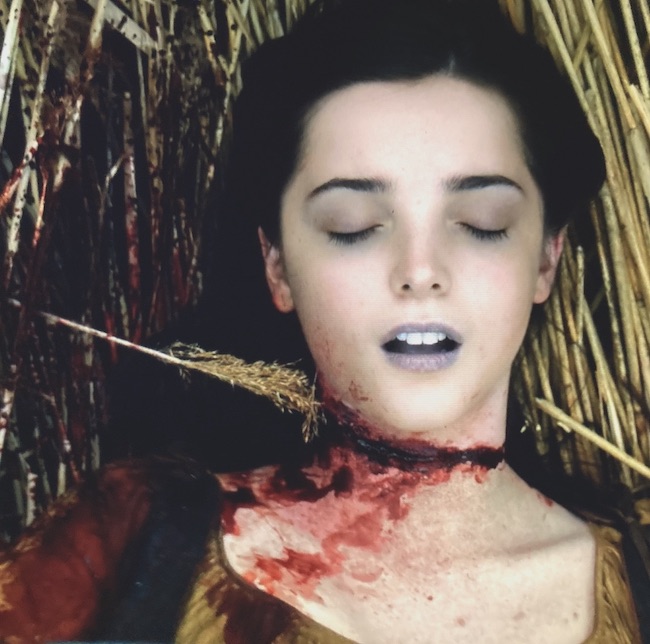
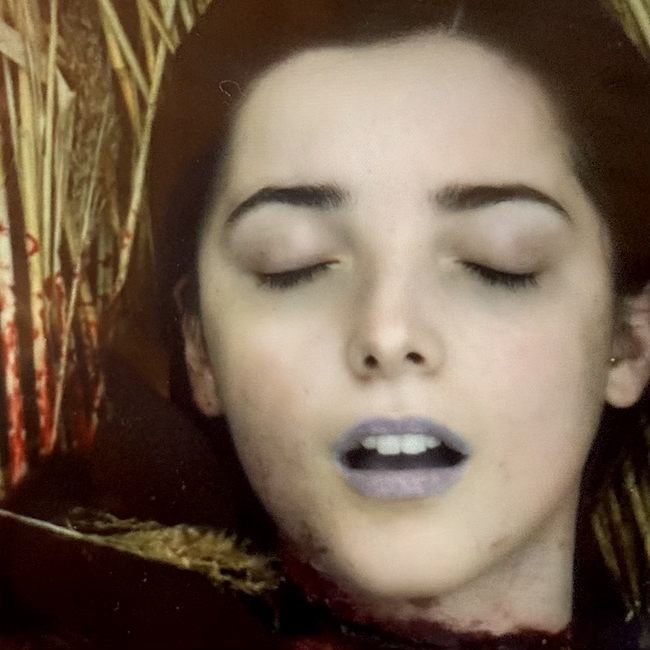
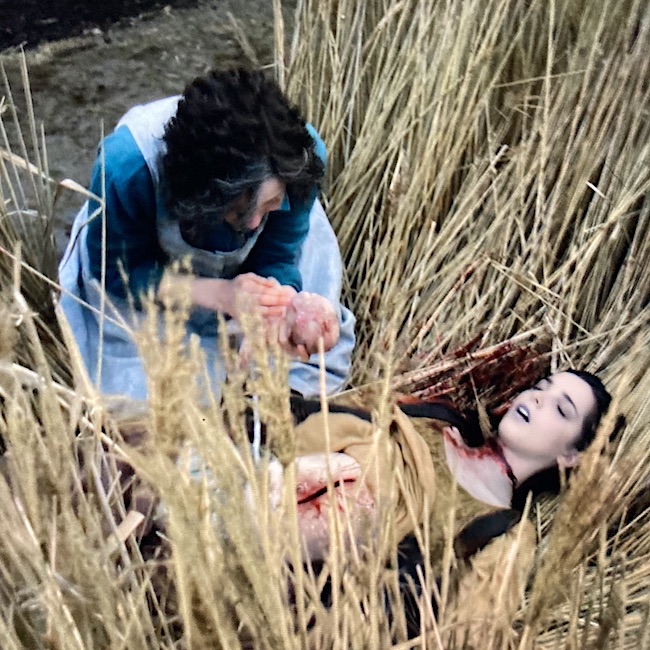
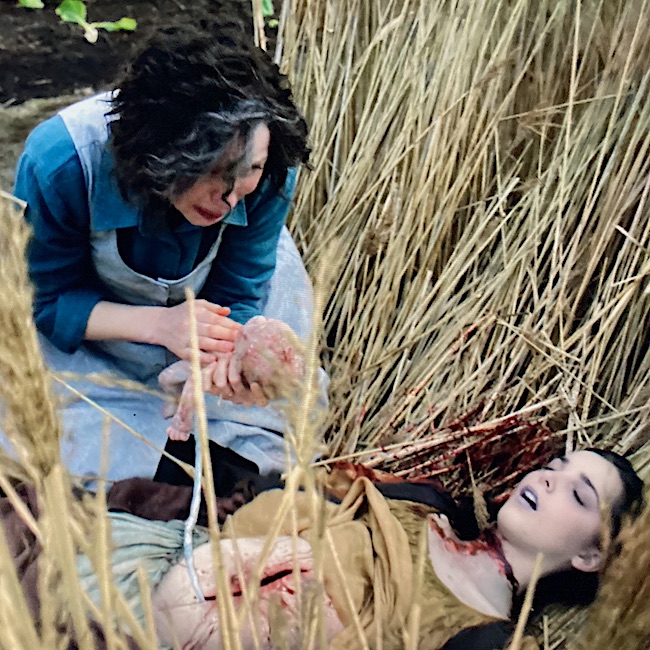
Never dreaming her beloved garden would be the site of a massacre, Claire spies Malva’s lifeless body, throat thoroughly mangled! 😯

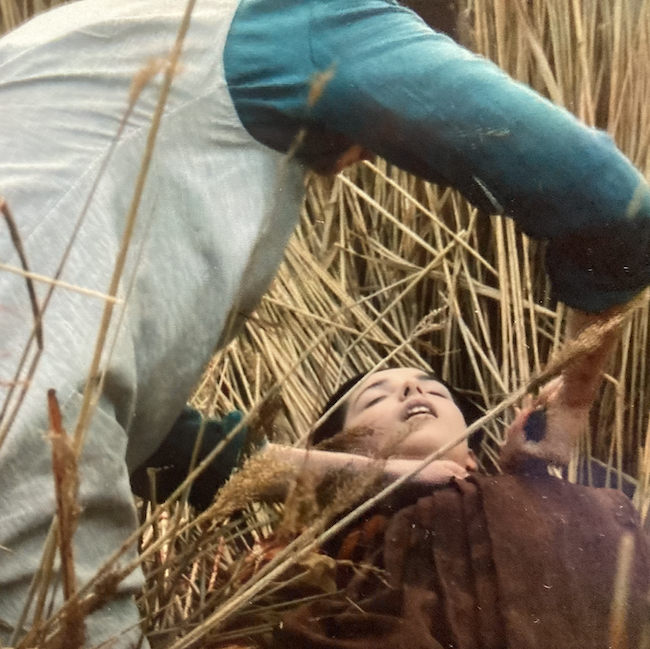
Realizing her infant may still be alive, Claire springs into action, slicing open Malva’s gown with her garden knife.

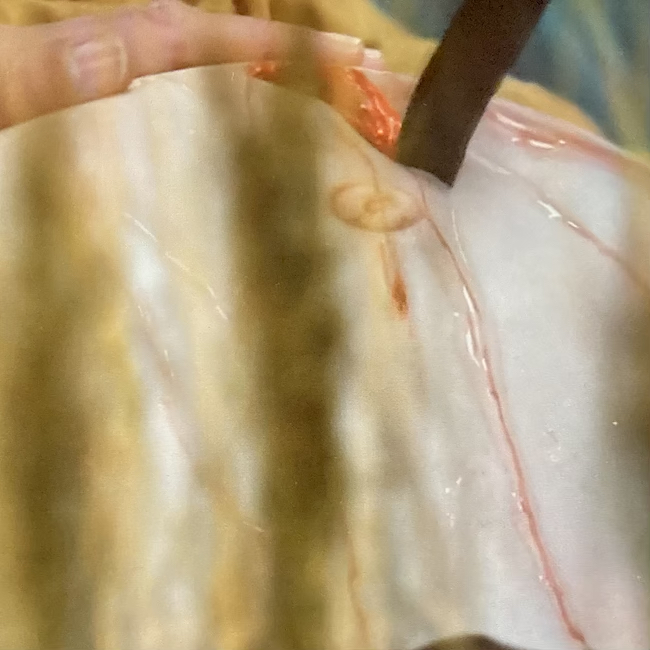
Moving with speed and surety, Claire slices Malva’s belly wall vertically and to the left of her navel, a vertical cesarean section. 

Claire works ruthlessly with such intent and determination that Malva’s lifeless body shutters from her efforts.

Claire releases the infant from the womb and realizing its life is fleeting.  She performs mouth to mouth resuscitation and chest compression using two fingers. But, alas, her efforts fail.

Goodness, this is hard to review, even using still images.

After this episode was over, my husband, who is not a book reader, turned to me and asked, “Is that in the book?” ‘Yes,” I answered. He remarked, “That is going to be hard to explain.” 

He then added, “ Now, they have to figure out who murdered Malva.

”Who do you think it might be,” I asked. 

“Well, I would look to the brother, first,” he said.

Amazed, I asked “Why?” 

His answer: “Because in patriarchal systems, male relatives often kill women who bring shame upon their families.”  (See footnote at end of lesson) đŸ˜Č 

‘Nuff said!

With this horrific scene as backdrop, let’s talk anatomy of the belly wall.

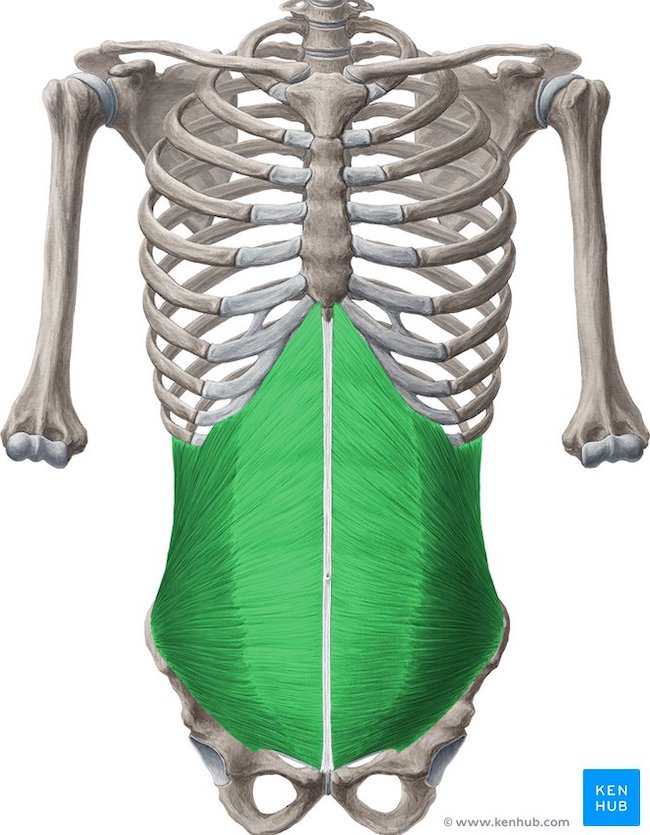
Abdominal Wall: The abdominal wall is a cylindrical region of the body bounded above by costal cartilages, ribs, and sternum (xiphoid) and below by iliac and pubic bones (green area in image below). 


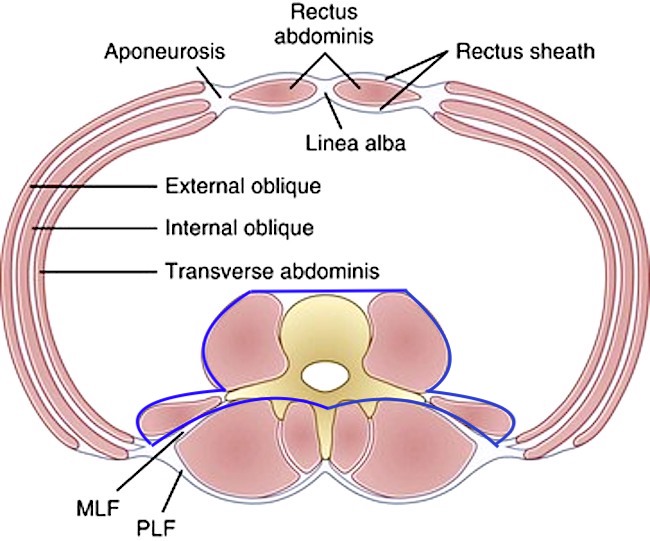
Anatomists typically divide the abdominal wall into anterolateral and posterior parts. The term, anterolateral, means the front (antero-) and sides (-lateral) of the wall. The term, posterior, refers to the back of the wall. 

These regions are best demonstrated in a cross-section (horizontal) through the torso. 

The figure below shows the two regions. The area bound by blue lines is the posterior abdominal wall. The remainder of the large pink oval is the anterolateral abdominal wall. (Psst
.Dinna fret about all the names. Will explain below). 

Anterolateral Abdominal Wall (AAW): Succinctly put, the anterolateral abdominal wall is the flexible and expandable part
. a.k.a., the belly. The posterior abdominal wall has limited flexibility and is unable to expand to any significant degree.

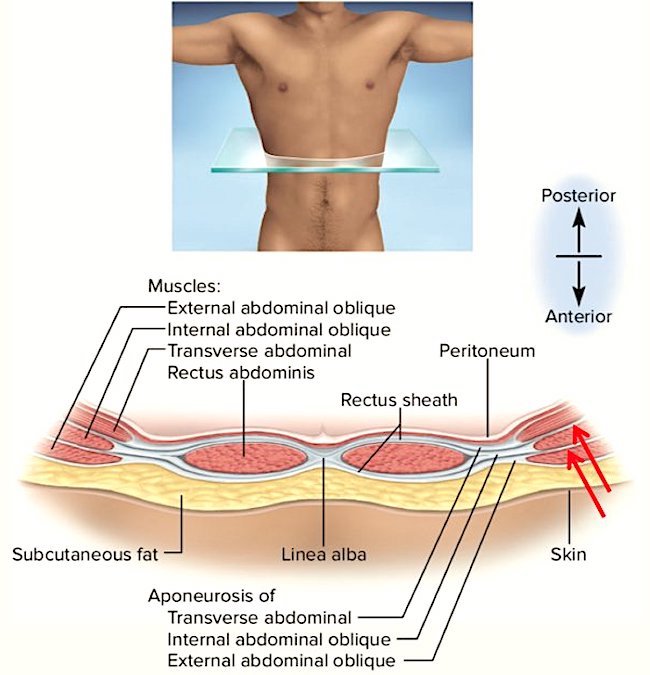
The main reason the AAW can expand is because it is made of soft tissue layers (no bones). The layers vary depending on the site. The following image is a cross-section of the AAW above the navel. 

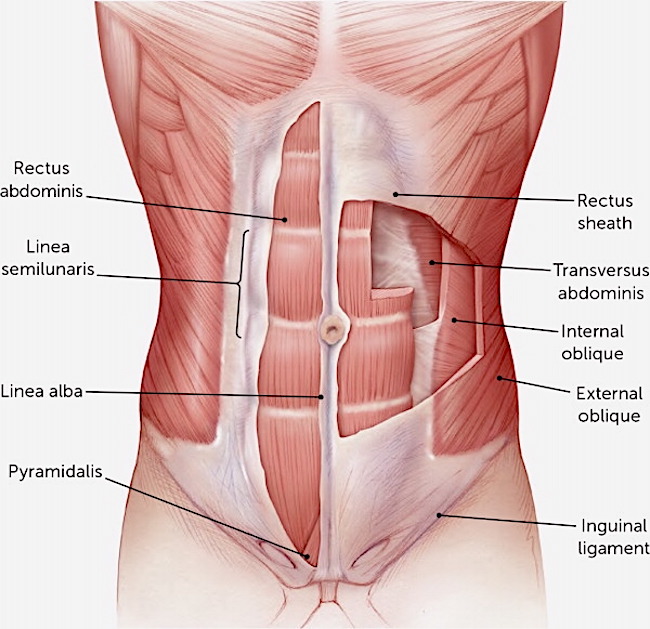
The central area marked as linea alba is a vertical line of connective tissue that unites right and left halves of the AAW. It is a nearly bloodless line and therefore can be cut with little blood loss.

On either side of the linea alba are right and left rectus abdominis muscles. These run vertically. 

Using the image below, at the sides of the AAW, three layers of muscle appear, from outer to inner: 

    • external abdominal oblique (EAO)
    • internal abdominal oblique (IAO) 
    • transversus abdominis (TA). 

The following image shows the muscle pattern  from a frontal (anterior) view. Note the linea alba. Clearly, the belly wall enjoys a good deal of muscular support.

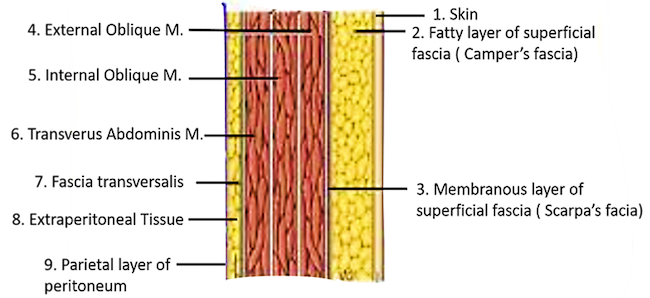
So, how thick is the AAW? Well, that depends on the individual. Moving to the next image, a magnified cross-section through the AAW, we find that the lateral AAW is composed of nine layers (three are muscle layers)! 

    • Skin
    • Fat layer (we accumulate varying amounts of fat in this layer)
    • Superficial fascia
    • EAO
    • IAO
    • TA
    • Transversalis fascia (connective tissue)
    • Extraperitoneal layer (more fat and connective tissue)
    • Peritoneum (membrane lining abdominal cavity

Nearer the midline,  AAW is composed of seven layers because it has only one muscle layer, the rectus abdominis. 

Either way, that is a LOT of layers!

Functions of the AAW: You might ask why is this part of the body designed to be flexible and expandable? Here are some reasons:

    • Maintains upright position
    • Moves the trunk (rotation, flexion, extension, bending sideways)
    • Protects abdominal viscera
    • Absorbs shock (remember BJR punching Claire in stomach in ep 106?)
    • Supports pregnancy
    • Increases intra-abdominal pressure (coughing, vomiting, childbirth, sneezing, defecation)

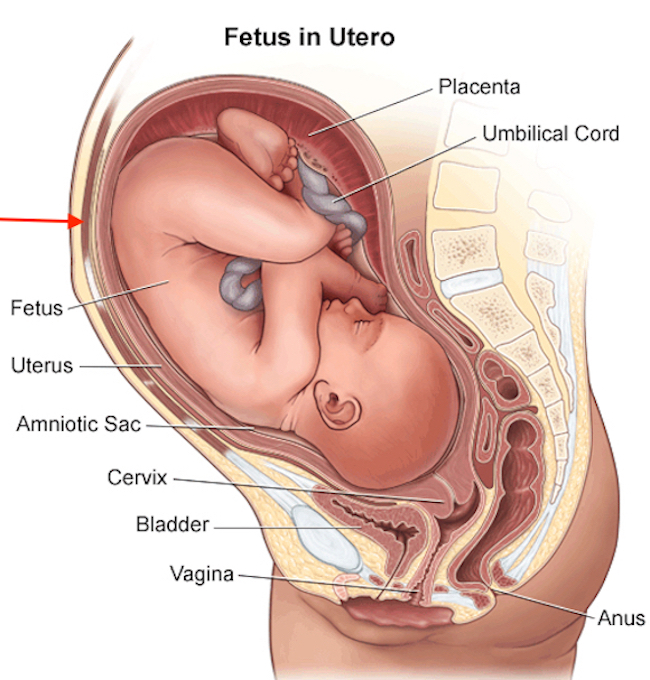
It is a darn good thing the AAW is flexible, especially for a pregnant woman. The next image shows a fetus during the third trimester. The uterine wall is labelled. The red arrow indicates the muscle layer of the AAW.

It as well as the other layers expand dramatically over the course of a pregnancy. The relatively slow growth of the fetus allows the belly wall to accommodate to the stretching, usually without tears, although these do occur (hernia).  This image is close to Malva’s condition when she was murdered.

So, there we have it in a nutshell, albeit a rather large one. We need an intact AAW to function well in our lives as it serves multiple purposes.

Learn more about the AAW in Anatomy Lesson #16, “The Abdomen.” There is much more to learn about this part of our anatomy – Lesson #16 explores this in greater depth. 

NOTE: The AAW is essentially the same in females and males except the groin region, there we find differences. Lesson #16 explains these.

FX: Now, how well did Starz FX do with Outlander 606? Pretty darn good if you ask me. Here are some examples:

    • As Claire begins her cut, there is a small stream of blood-tinged fluid which is consistent with the location of the cut, that is, very near the linea alba (see above). There would be little blood flow at this point as the cut is only through the belly wall. 
    • Malva’s navel does not look realistic because it appears largely normal. In late pregnancy, it usually pooches outwards due to increased intra-abdominal pressure.
    • The pink tissue underlying the skin is fat. It is a bit thick for Malva who is a trim young woman.
    • After Claire’s knife pierces the uterine wall and she removes the infant, the C-section now appears dark red because the uterus receives a huge blood supply during pregnancy. Well done. 
    • Malva’s infant is covered with blood-tinged material, the vernix, a waxy coating to protect the infant’s skin. Yay!
    • Malva’s belly is slightly concave after the infant was removed. Horrible, but accurate. 
    • Mouth-to-mouth on such a tiny person should be done with less force than Claire used – third trimester lung volume is calculated at less than 2 tablespoons per lung! This can accommodate a very tiny amount of air.
    • Claire doing two finger chest compression to stimulate the heart is spot on.

Yay, Outlander! Kudos to the FX folks!

Read about Claire’s emergency C-section in Diana’s sixth big book, “A Breath of Snow and Ashes!”

I smelled the blood and saw her in the same instant. She was lying in the salad bed, her skirt flown out like some gigantic, rusty flower blooming amid the young lettuces. 

I was kneeling by her, with no memory of reaching her, and the flesh of her arm was warm when I grasped her wrist—such small, fragile bones—but slack, there was no pulse—Of course not, said the cold small watcher inside, her throat is cut, there’s blood everywhere, but you can see the artery isn’t pumping; she’s dead. 

Malva’s gray eyes were open, blank with surprise, and her cap had fallen off. I clutched her wrist harder, as though I must be able to find the buried pulse, to find some trace of life 
 and did. The bulge of her belly moved, very slightly, and I dropped the flaccid arm at once and seized my knife, scrabbling for the hem of her skirt. 

I acted without thought, without fear, without doubt—there wasn’t anything but the knife and the pressure, the flesh parting and the faint possibility, the panic of absolute need


I slit the belly from navel to pubis, pushing hard through slack muscle, nicked the womb but no matter, cut quick but careful through the wall of the womb, dropped the knife, and thrust my hands into the depths of Malva Christie, still blood-warm, and seized the child, cupping, turning, wrenching hard in my frenzy to pull it free, bring it out from sure death, bring it into the air, help it breathe.
 Malva’s body flopped and heaved as I jerked, limp limbs flailing with the force of my yanking. 

It came free with the suddenness of birth, and I was swiping blood and mucus from the tiny sealed face, blowing into its lungs, gently, gently, you have to blow gently, the alveoli of the lungs are like cobwebs, so small, compressing its chest, no more than a hand’s span, two fingers pressing, no more, and felt the tiny spring of it, delicate as a watch spring, felt the movement, small squirms, a faint instinctive struggling—and felt it fade, that flicker, that tiny spark of life, cried out in anguish and clutched the tiny, doll-like body to my breast, still warm, still warm. 

“Don’t go,” I said, “don’t go, don’t go, please don’t go.” But the vibrancy faded, a small blue glow that seemed to light the palms of my hands for an instant, then dwindle like a candle flame, to the coal of a smoldering wick, to the faintest trace of brightness—then everything was dark. 

I was still sitting in the brilliant sun, crying and blood-soaked, the body of the little boy in my lap, the butchered corpse of my Malva beside me, when they found me.

Puir Claire! Puir Malva! Puir wee one!

See Claire as she realizes that all is lost. Mother and child are gone – grief, loss, and futility grip the Good Doctor.

The deeply grateful,

Outlander Anatomist

Follow me on:

Photo Credits: Starz; www.aafp.org; www.anatomyqa.com; www.kenhub.com; www.musculoskeletalkey.com; www.quora.com; www.stanfordchildrens.org

Footnote: In 2017, the United Nations Office on Drugs and Crime reported 87,000 killings of women worldwide – 58% were killed  by family members  or intimate partners! Alarming stats!